All Access Pass to Yosemite

Yosemite National Park is a secluded wilderness with sheer granite cliffs and rapid whitewater. These same features that make it spectacularly beautiful might also make you think it’s an inhospitable place to visit for someone with significant mobility limitations. Well, think again because it’s surprisingly accessible to the traveler with a disability.

View of Yosemite Valley from tunnel viewpoint
Yosemite Valley

I recently returned from my first trip to Yosemite since I was a young boy. While there are many different types of disabilities to adapt travel to, I’ll keep this article focused on what a quadriplegic visiting Yosemite will encounter. First of all, it will keep the article shorter but, more importantly, I can speak from my own experience.

The first night, we stayed at the Yosemite Gateway Inn, some 45 miles away from the heart of the Yosemite Valley. By any standards, it’s a quaint and comfortable hotel with reasonable fees, so I would recommend it to anyone staying in Oakhurst (just fourteen miles south of the entrance to the park). But it also offers excellent wheelchair accessible rooms.

The disabled person parking space is adjacent to the room we stayed in. It has a crosshatch area big enough to accommodate a side entry and a ramp to the walkway. The entry to the room has no lip at the threshold and a wide doorway. Inside, there’s plenty of room to maneuver a wheelchair around the beds. The bathroom also has enough space to easily turn a wheelchair around and a large, curbless (or “roll-in”) shower. The sink has no cabinetry beneath it so there is room to roll your knees and lap up underneath. The toilet accommodates a commode wheelchair.
National Park Service Access Pass
Access Pass

The next morning, we headed to the park. Although most visitors pay a nominal fee for a seven-day permit to access Yosemite, the National Park Service offers an “Access Pass” to visitors with a permanent disability. To qualify, I showed my disabled person parking placard and signed a form affirming my disability. There is no charge for an Access Pass and it permits the holder and a companion unlimited entry to any United States National Park for a lifetime.

Photograph of giant sequoias named Bachelor and Three Graces
Bachelor and Three Graces in Mariposa Grove

Just inside the gate to the park is the Mariposa Grove Welcome Plaza where most people who want to visit Mariposa Grove have to park, then they can catch a wheelchair accessible shuttle or hike a couple of miles up a paved service road to get to the grove. But the park service allows vehicles transporting persons with disabilities to drive the road. Upon arriving at the grove, there are parking and restrooms that are all wheelchair accessible. From the parking area, the half-kilometer-long Big Trees Loop Trail and a section in the Grizzly Giants area are easily navigated in a wheelchair and provide unobstructed views of a grove of Giant Sequoias—the largest species of trees on the planet.

Bridalveil Fall
Bridalveil Fall

One of the first landmarks you’ll visit after entering Yosemite Valley is Bridalveil Fall. There is disabled person parking both in the lot near the base of the fall as well as in the lot on Southside Drive. There is an impressive view of the falls from either parking area and, in 2023, the park opened a trail that is wheelchair-accessible right up to the base of the fall.
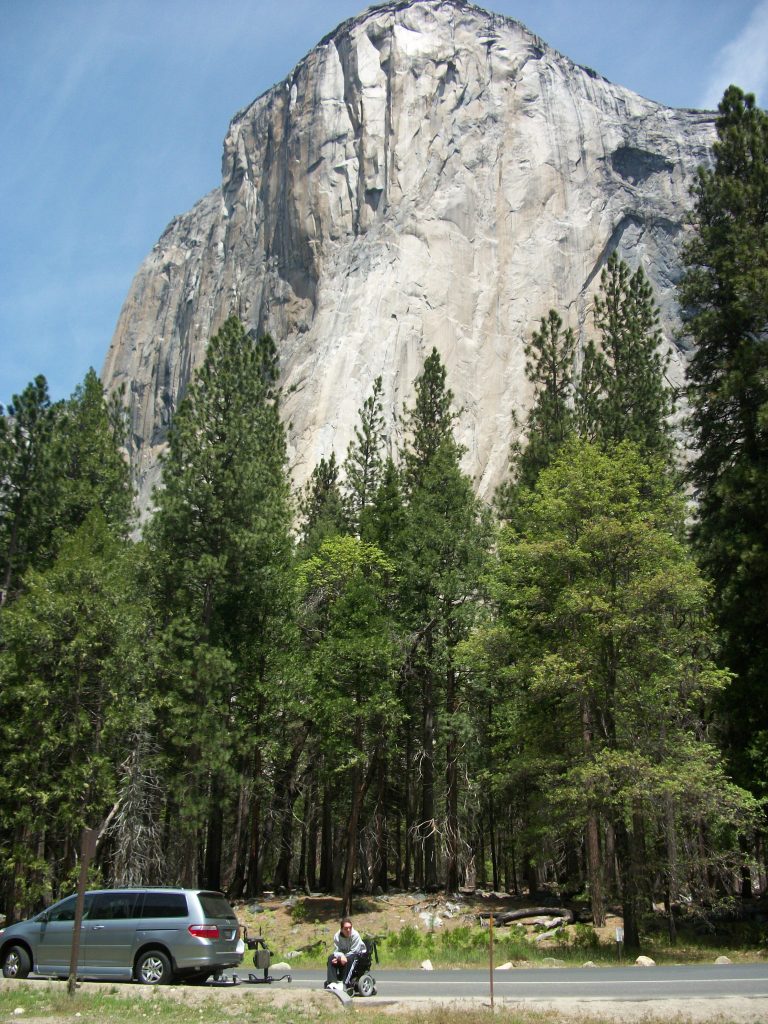
El Capitan dwarfing me and my wheelchair-accessible van parked at the base
El Capitan

Likewise, there is no wheelchair accessible trail to the base or top of El Capitan. But as the most imposing feature in the Yosemite Valley (and the largest granite face on the planet), there are breathtaking views of it from many accessible locations around the floor of the valley. Park just about anywhere within view of El Capitan and look up…and up and up. Your view of it will be every bit as awesome as that of any able-bodied person in the park.

Curb cut on path into the Ahwahnee Hotel
The Ahwahnee Hotel

We stayed at The Ahwahnee Hotel while in the Yosemite Valley. The wheelchair accessibility of the parking and the entry made me feel good about my choice of lodging. Unfortunately, the room immediately dispelled me of that notion. The beds were luxurious—too luxurious. With thick pillow-tops on both sides of the mattresses, they ended up too high to easily transfer into from a wheelchair. The sink in the bathroom was beautiful English porcelain certain to appeal to the classiest able-bodied guest but the ergonomics were all wrong for me. It was not easy to roll my legs underneath and the top of the counter around it was too high and rounded for someone with a manual impairment to deal with easily. The shower was curbless but it was tight with only front access, so a caregiver cannot easily assist. The toilet was taller than normal, so my commode chair could not access it. Lastly, although the hotel is noted for having beautiful views from almost every room, the wheelchair accessible room we used had no view at all from the windows.

Wheelchair accessible room at Ahwahnee Hotel
Wheelchair accessible hotel room

In all fairness to The Ahwahnee Hotel, it’s a first-class resort that I would recommend to any able-bodied person visiting Yosemite. Plus, the staff bent over backwards to accommodate me by, for example, bringing a thinner mattress from the lodge up to our room. Nonetheless, I do not recommend the wheelchair accessible rooms at The Ahwahnee Hotel for a quadriplegic.

Map indicating wheelchair accessible trail to Yosemite Falls
Yosemite Falls signage

The next day, we visited Yosemite Falls. The signage made it easy to find the wheelchair accessible trail all the way to the base of the fall. The National Park Service clearly went to great lengths to make the trail accessible while still blending in well with the natural surroundings. The force of the falling water is so strong that it creates a brisk wind and heavy mist in the air at the base of the falls, so bring plenty of layers of clothing with you if you chill easily, even on a warm day.
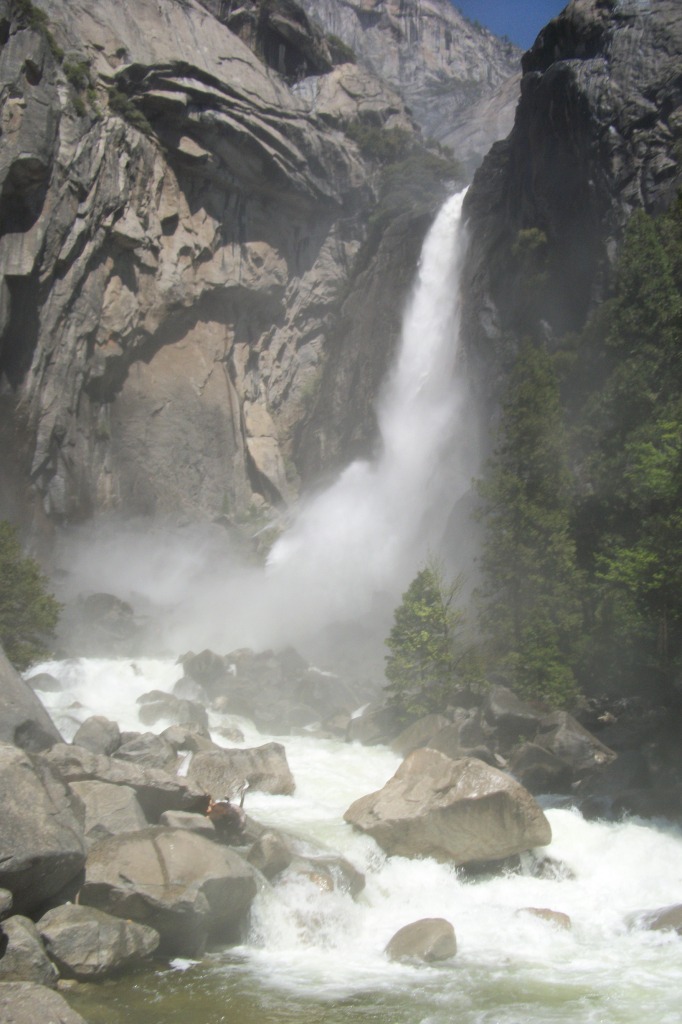
Lower Yosemite Fall with mist rising at the base
Lower Yosemite Fall

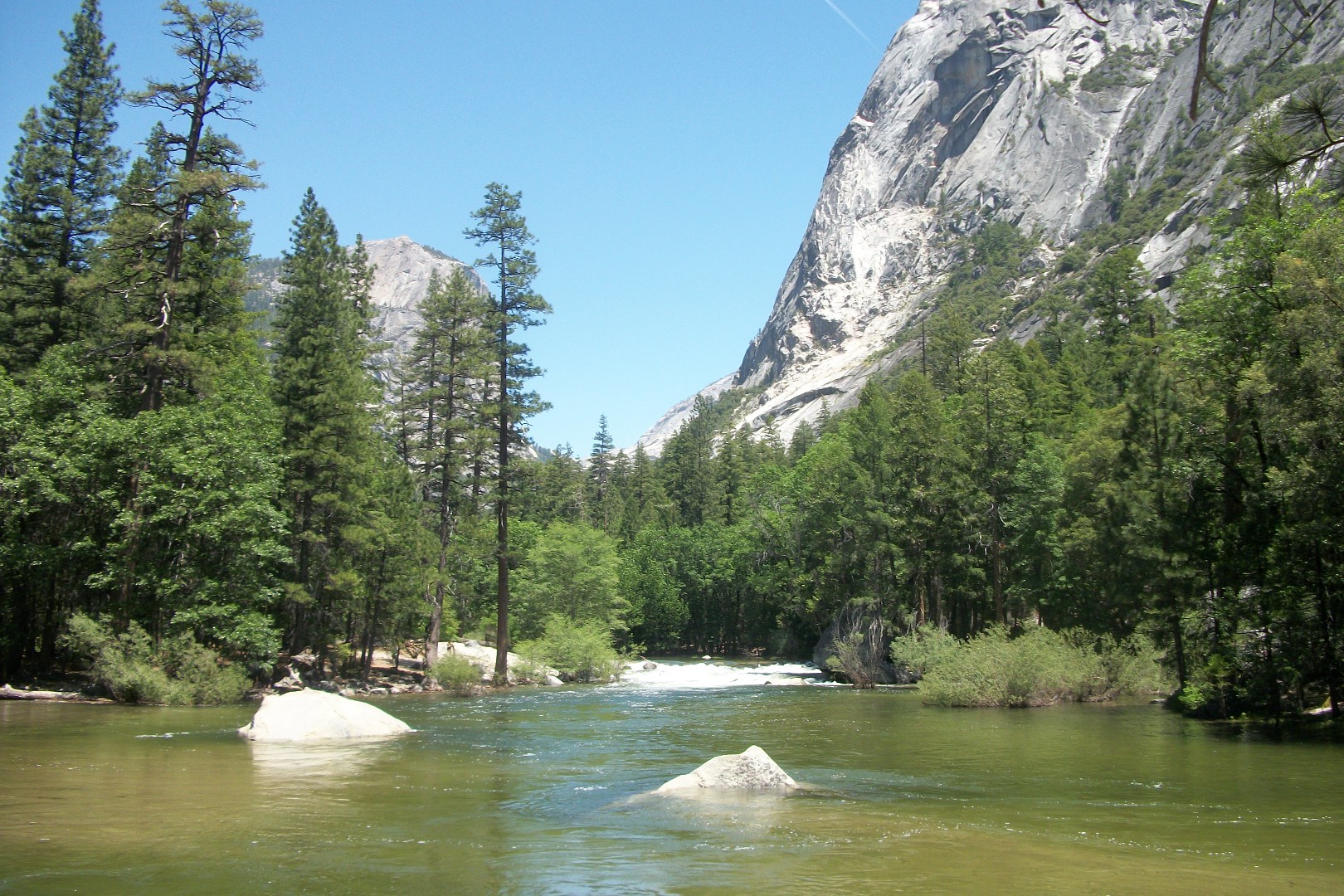
For a close-up view of Half Dome from its base, visit Mirror Lake. The service road to the lake is closed to most traffic but they permit vehicles transporting persons with disabilities to slowly drive it with the hazard lights blinking. At the end of the service road is wheelchair accessible parking and bathrooms. From there, a paved trail traverses a few hundred yards of the lake’s shoreline. Once the paved trail ended, I continued down the foot trail. I was surprised to find that I was able to continue down the Mirror Lake trail well over a half mile in my wheelchair without any assistance. Had I not discovered that the charge on my battery was running low, there’s no telling how much further I could’ve ventured into the woods.
Mirror Lake
Mirror Lake

On our way out of the park, we drove to Glacier Point. The parking area has wheelchair accessible spaces and restrooms. From there, it’s a quarter mile to the viewpoint overlooking the Yosemite Valley. The signage directs you to the paved trail through the woods with switchbacks so that it’s not too steep for a wheelchair. At the end of the trail, you can roll your wheelchair right up to the edge of the cliff and look down over the Yosemite Valley or have a photo taken of you with Half Dome over your shoulder.

Signage directing visitors to wheelchair accessible trail to Glacier Point
Glacier Point signage

Granted, you can’t go everywhere in Yosemite using a wheelchair. Nonetheless, you can access much more of it than you’d expect, so don’t let concerns about wheelchair access stop you from visiting Yosemite National Park. And the National Park Service deserves recognition for the thought, effort, and cost they’ve obviously put into making it as accessible to visitors as possible.

The Progressive with Half Dome in background
Half Dome

Evidence for evolution reinforced

People who do not believe in evolution had some seemingly sound arguments against the theory. Unfortunately, those people now have two fewer legs to stand on. Two arguments commonly used against evolution have now been refuted.

One of the widely known arguments is the watchmaker analogy. It says that the complex inner workings of a watch could only come to be through the act of an intelligent designer. Therefore, as with a watch, the complexity of a given life form could only be created by intelligent design.

It turns out that evolution is a blind watchmaker after all. A doctor of molecular neuroscience wrote a computer program that emulates the process of natural selection using the component parts of a watch. He found that a functioning watch could, in fact, evolve from its independent parts without any intelligent design.

Another argument commonly posited is that no fossil evidence has been discovered that shows one species evolving into another. People who ascribe to this argument postulate that, considering the countless species that have existed on this planet, there must be abundant fossil evidence of this speciation if evolution really occurred. Since there is no such evidence, there has been no evolution.

It was long assumed that man had to look into fossil history for evidence of speciation since written history is too short to observe a species splitting into two separate species. It turns out that mankind need not look back tens of thousands of years for evidence of speciation—they need only to look to the Galapagos islands. The birth of a new species has now been witnessed by scientists. A husband-and-wife team of biologists have witnessed that elusive moment when a single species of Galapagos finches split into two separate species within what turned out to be a surprisingly short period of time.

Proponents of Intelligent Design now need to postulate two new arguments against evolution.

My dozen

My friend made a post to his Facebook where he attempted to list every concert he’d been to. He tagged me (and some of his other friends), challenging me to list every one that I had been to. Considering that I’ve been to hundreds of concerts over the span of more than three decades, there’s no possibility that I could list every concert I’ve been to. So instead I decided to post the dozen most notable concert experiences I’ve had.

  1. CaliFFornia World Music Festival posterCaliFFornia World Music Festival
    Day 1 only – April 7, 1979
    Los Angeles Memorial Coliseum
    Who could forget their very first concert experience? Day one of this festival included Ted Nugent, Cheap Trick, Cheech & Chong, Toto, REO Speedwagon, Black Sabbath, and Journey, among others. We worked our way up very near the stage. It was so crowded there that, when my friend passed out, he remained standing.

  2. The Police
    Approx. 1981
    Sunrise Musical Theater
    The first time I saw The Police in concert was on the Zenyattà Mondatta tour. What made this concert particularly memorable was the back seat of my car going up in flames on the drive up to the show. My buddies and I didn’t let that dampen our enthusiasm one bit. We just hauled the entire bench seat—which by then was a raging bonfire—out of the car and left it burning on the side of the Florida Turnpike, hopped back into my 1972 Cadillac Coupe de Ville, and headed on our merry way into Sunrise. I saw them again over a quarter of a century later when The Police reformed for a reunion tour and you can read about that in We don’t need no stinking badges.

  3. Rolling Stones
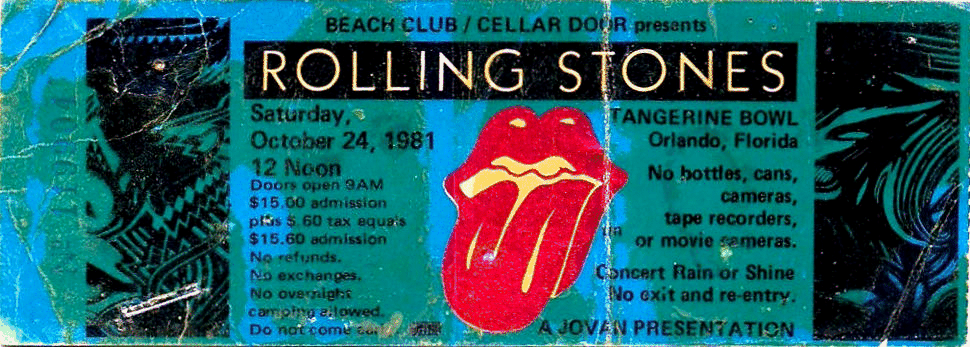
    October 24, 1981
    Tangerine Bowl
    Rolling StonesJohn and I drove all the way from Miami to see The Stones. The Tattoo You tour was the first of about a dozen “farewell tours” The Stones have played. The Stones had a band called Van Halen (Perhaps you’ve heard of them?) open for them. It was the last time Van Halen opened for another band. Personally, I liked Van Halen’s show better than The Stones’. David Lee Roth had even better moves than Jagger.

  4. The US Festival
    September 3-5, 1982
    Glen Helen Regional Park 
    This was the rock festival to rival Woodstock. It was held in an immense natural amphitheater with nothing less than the San Bernardino Mountains and the San Fernando Mountains backdropping a huge stage. It’s impossible to sum up three sunny days with a million people and fifteen major acts in a paragraph. All I can say is, the US Festival will forever remain unequaled as the greatest concert experience of my life. If you can handle the full uncensored story, read My 1982 US Festival Trip.
    Three-day ticket to The US Festival in 1982

  5. The Who
    October 29, 1982
    Los Angeles Memorial Coliseum
    It was just me, Scott, and 100,000+ of our closest friends in the Coliseum with festival seating and The Clash. What, you ask, is so notable about that? The Who headlined! Enough said.

  6. Supertramp
    September 25, 1983
    Irvine Meadows Amphitheater
    Mike and I were fortunate enough to sit in the twelfth row for this concert. The Meadows was a beautiful, open-air amphitheater built on the side of a hill. Because of this theater’s great sound reinforcement, we could really appreciate the layered vocal harmonies, percussion, and woodwind instruments of a Supertramp show. With a setlist eighteen songs long, they played for hours and their performance was spotless. They seemed to be on an emotional high. During the intermission, we found out why. It turned out to be the last show that founding member Roger Hodgson played with the band, so they presented him with a gold watch.

  7. The Tubes
    Approx. 1986
    Ceasar’s Tahoe
    How do you explain a Tubes show to someone who’s never seen one? To say it’s outrageous and over-the-top doesn’t begin to do it justice. The stage was set with over-sized props and beautiful women in skimpy costumes dancing all over. Fee Waybill has an amazing imagination and boundless creativity, so the show was a feast for the eyes. Yet the musicianship of the band is so excellent that the music easily holds its own with the stage production. Not being gamblers, Mike and I went to the show looking for a way to pass the evening at South Lake Tahoe after a day of great snow skiing. We lucked out and were seated almost within an arm’s length of the stage.

  8. Eagles
    May 29, 1994
    Irvine Meadows Amphitheater
    This show turned out to be opening night of the Hell Freezes Over tour—the first time the band had played for a paying audience in fourteen years. There was this atmosphere of anticipation and build-up for this show that the band fed off of. Subsequently, the Eagles were in particularly rare form. By this time, I was using a wheelchair but, there under the stars on a beautiful summer night with my bro Jim, the wheelchair-accessible seating had a great view.

  9. Elton John and Billy Joel
    Approx. 1997
    The Forum
    Elton John and Billy Joel co-headlined on the Face to Face tour. I had previously seen Billy Joel in concert but had not seen Elton live, so Jim and I decided it was again time to see a show together. We were able to get the wheelchair seating near the left side of the stage in the first row of the upper-level, so it’s unobstructed. There was a Jumbotron directly in front of us, PA speakers on either side, and the stage laid out below us. Elton John opened the show with his band, playing a rocking set. Then the crew brought out a second grand piano and Billy Joel joined him on the stage. After another long set, Elton retired backstage and Billy Joel played a set with just his band. Finally, Elton rejoined him for a long encore.

  10. Santana
    October 14, 2005
    Dignity Health Sports Park
    I had been to numerous soccer games at the Home Depot Center but I was unfamiliar with the wheelchair seating for concerts. When Santana was going to play there, I decided to find out. Imagine my surprise to discover I could sit in the front row and my greater surprise to find out there was still wheelchair-accessible seating available! With seats that close, I had to buy tickets, even though I had already seen Santana live three times previously. Since the soccer field (where the stage is set) is below street level at the Home Depot Center, it turned out the only way to get there in a wheelchair is to take a freight elevator which opens up backstage. From there, Michael and I found our way to the field and over to the wheelchair seating area situated directly in front of the stage. After the show, we had to go backstage again to leave and were fortunate to encounter some of the band members there (although we did not get to meet Carlos).

  11. Van Morrison
    March 5, 2006
    The Wiltern
    By the time I saw this show, I had started The Progressive Zone, so for the full story on this show, read Van Morrison at The Wiltern.

  12. Roger Waters
    June 15, 2007
    Irvine Meadows Amphitheater
    For the full story on this show, read When pigs fly!

For every show listed above, I’ve probably seen a dozen other concerts whose story has yet to be written. They include acts like Queen, U2, Simon & Garfunkel, Yes, the Doobie Brothers, Rush, and Steely Dan—some of them numerous times. In fact, I’m sure there are many acts I’ve seen that I don’t even remember. So to keep things simple, I’ll end my list here with just a dozen of the most memorable concerts.

Health care reform means a single-payer system

Where is the change President Obama spoke of in his campaign? It certainly is not in the form of the health care reform bills going through congress right now. I still have hope that the bill that finally gets signed into law is real health care reform but things are moving in the wrong direction right now. The problem is that insurance companies are still at the core of the various bills being developed right now.

As long as for-profit insurance companies are part of the equation, health care will not see reform. Marcia Angell, a physician and Senior Lecturer in the Department of Social Medicine at Harvard University Medical School and the first woman Editor-in-Chief of the New England Journal of Medicine, put it well when she said:

We are the only advanced country in the world that has chosen to leave health care to the tender mercies of a panoply of for-profit businesses, whose purpose is to maximize income and not to provide health. And that’s exactly what they do.

Dr. Angell was referring to Obama’s position that Americans who do not get health insurance from their employers be mandated to purchase it under the health care reform plan. She says that by so doing, “We’re going to deliver the private insurance companies a captive market…And they love that.”

In fact what we need to do is eliminate the market—at least from the insurance companies—by creating a single-payer plan. Insurance companies deliver no value to patients or recipients of health care whatsoever in the current health care system. All they do is generate costs—almost one-third of what Americans are currently paying for health care goes to administration by health insurance companies.

Opponents of a single-payer system say that patients would get no choice in their health care. It would be completed dictated by the government. But the evidence contradicts this assertion. Dr. Angell goes on to point out about this claim:

It’s phony, in the sense that Medicare is a single-payer system, embedded within our larger market-based system. You have totally free choice of a physician in Medicare. You don’t in most employer-sponsored private plans. Canada, totally free choice of doctors. So, this is simply not true.

Opponents also claim that a single-payer system would lead to rationing. But the fact is that it’s our current “free market” system that rations health care by providing it to the insured and denying it to the poor and uninsured. In fact, even middle class families are falling victim to the status quo: sixty percent of bankruptcies are caused by health problems. Dr. Angell says:

If we continue to spend what we do, right now, on health care, but had a system that distributed it according to medical need, there would be no rationing. And if we held it at that cost, there would never be any rationing. So, it’s simply not right. The problem is not the money, it’s the system.

The system America needs right now is a single-payer system. Just a year ago, President Obama said, “If I were designing a system from scratch, I would probably go ahead with a single-payer system.” Even though congress is not designing a system from scratch, a single-payer system is still the only real way to reform health care if we want a sustainable and affordable system.

Respect privilege

It’s not easy going through life with a disability. Fortunately, people with disabilities get an occasional privilege. One of them is the use of disabled person parking spaces. It helps make one small aspect of life a little easier.

Nonetheless, the privileges need to be respected. When taken for granted, the person doesn’t appreciate the privilege. When a person has a sense of entitlement to privileges, it leads those without them to begrudge the privileged. So even a person with challenges in life and few privileges should take care not to abuse them.

When Bob Shatney, a paraplegic man, was being cited for parking in a disabled person parking space, he was surprised. Even though he had neither a disabled person placard nor disabled person license plates, Shatney felt he should not be cited.

Shatney had just bought a new car, so he did not have his disabled person plates yet. But Shatney also qualifies for a disabled person placard. He could use the placard until the plates arrived. Instead, Shatney felt that having his wheelchair in the back seat and hand controls for driving entitled him to use the disabled person parking space, even though the law said otherwise.

The law says that the disabled person placard must be displayed when parking in a disabled person parking space. In fact, it says that the person must show the registration for the placard when a law officer makes the request. The law does so for a couple of reasons. One is that abuse of disabled person placards is rampant. Another is that many people have “invisible disabilities” where you cannot see that they have a disability by observing them walking from their car parked in a disabled person parking space.

There is no exception in the law for people with wheelchairs or for having hand controls in their car. If there were, some people without a disability would find yet more ways to take advantage of disabled person parking. The law protects the privilege of the driver or passenger with a disability. It should be respected by the beneficiaries of the privilege.

As for Shatney, his citation was canceled. Because he demonstrated that he had the legal right to use disabled person parking, the local police sergeant canceled the citation. That’s fair to Shatney, but it was also fair that he was cited in the first place.

The adapted driving cautionary tale

Buying a van adapted for driving from a wheelchair is a costly investment. Depending on the scope of adaptations needed, the price can even run into six-figures. This is obviously not a purchase to take lightly.

Nonetheless, it can be a critical investment for a person with a disability. An adapted vehicle can provide that person with independence most people take for granted but that is otherwise unattainable for someone with a significant mobility impairment.

Considering all this, one would hope that making the purchase would go smoothly. After all, activities of daily living are challenging enough for someone with a major disability. That person would hope that their purchase is sure to be hitch free. Unfortunately, it’s not—even in the most uneventful of purchases.

First of all, at least for the initial purchase, the driver must undergo a driving evaluation given by a team that includes an occupational therapist and a rehabilitation engineer who specialize in adapted driving before even ordering a vehicle. Secondly, funding is a challenge and most traditional lenders won’t provide a loan for an adapted vehicle because of the high cost relative to the Blue Book value. Finally, the driver must have at least two fittings before delivery just to ensure the van is configured appropriately for the individual.

After all this, my most recent purchase of an adapted van went from a major hassle to my worst nightmare. I chose the same dealer from which I had purchased my prior two adapted vans, ADS Mobility. ADS had been in business for almost thirty years and had a good reputation in the industry. In my prior two purchases, the dealer did its best to provide quality service to me and they fully rectified the one accidental incident that occurred. This last purchase was a different story altogether.

First of all, ADS delayed delivery of my van for months. The owner, Chuck Kutz, fed me excuse after excuse, blaming all the delays on his suppliers. I have since discovered that all of the excuses were lies. I now speculate that what actually happened is ADS probably misappropriated the payment I made for the vehicle and did not use it to purchase the base Honda Odyssey Northstar conversion and all of the additional adapted driving equipment I require. Instead, it was probably used for ADS’s other expenses and then Kutz probably had to wait for sales to later unfortunate customers to use their payments to acquire my van and equipment over the subsequent months.

Part of the equipment that ADS contracted to install in my van was an AEVIT L Series system. This system costs well into five-figures all by itself plus thousands of dollars more to install. When I finally received my van, it had a used EGB SS electronic gas and brake system installed instead. This is an obsolete (albeit reliable) predecessor to the AEVIT system that hasn’t been manufactured since 2001 and which the manufacturer doesn’t support anymore.

The reason why ADS mangled my transaction has now come to light. The dealership went out of business and closed up shop. No other address or phone number was given to any customers for any kind of follow-up service on undelivered purchases, which happened to be the state of mine at the time. The owner has gone into hiding and is incommunicado. Fortunately (sort of), my van was abandoned at a distant Honda dealer, so I was able to retrieve it.

The van had the temporary registration vehicles have when first delivered by dealers. I checked with the Department of Motor Vehicles to determine when they would send me my permanent plates and discovered that ADS had neither processed my registration nor paid the taxes and fees. Of course, I had already paid ADS thousands of dollars to do so. Unfortunately, ADS left it up to me to process the registration and pay the taxes and fees—yet again!

Is this tale over? I hope so but it might not be. Other people who recently bought adapted vans from ADS have actually had their vans repossessed by ADS’s supplier. It turns out ADS didn’t pay its supplier for a fleet of vans and Kutz absconded with the unfortunate buyers’ monies.

ADS Mobility was QAP Accredited by the National Mobility Equipment Dealers Association (NMEDA). This Quality Assurance Program (QAP) accredited what, in this case, turned out to be a very low quality and crooked dealership. In all fairness, the QAP is a well designed program and is a strong indicator that an accredited dealer can be relied on to deal in good faith with its customers. Nonetheless, a dealer bent on ripping off its customers can still become QAP Accredited by defrauding the NMEDA, just as it does its customers.

Buyers of adapted vehicles should not rely solely on any such indicator that their dealer will take care of them. Let this tale be a warning to act with great caution when purchasing such an expensive and critical vehicle. Before paying the dealer, try to determine what comprises the dealer’s inventory of vehicles and equipment. Try to identify your own vehicle as early as possible and verify that no suppliers have a lien on its title. And whatever you do, avoid dealing with Chuck Kutz like the plague!

Honda Odyssey van with VMI Northstar conversion
Honda Odyssey Northstar

Putting the ‘home’ into homeopathy

The decline in home values is hurting millions of Americans. After all, many had built up a great deal of equity in their homes by the time values had reached their peaks. Now the rates are resetting on many homeowners’ ARMs and the monthly payments are increasing to the point of unaffordability. In the meantime, their equity has evaporated and they are underwater with their mortgages. The only option left if they can’t afford to service their debt is a short sale or foreclosure.

The obvious course of action is to reverse the direction of the trend in home values, right? Wrong! Declining home values are not the disease, they’re the symptom, so turning them around is not the cure. Or as Alan Reynolds, a senior fellow with the Cato Institute and the author of Income and Wealth put it, “Falling home prices are not the problem, they’re the solution.” The cure for home values is some homeopathic medicine—that is, the feds keeping their hands off the housing market and letting homes return to their intrinsic values.

President Barack Obama disagrees. Earlier this month while remarking on the mortgage crisis, the President said:

In the end, all of us are paying a price for this home mortgage crisis. And all of us will pay an even steeper price if we allow this crisis to continue to deepen—a crisis which is unraveling home ownership, the middle class, and the American Dream itself. But if we act boldly and swiftly to arrest this downward spiral, then every American will benefit.

His solution is the Homeowner Affordability and Stability Plan. His plan has four key elements:

  1. financing help for four- to five-million homeowners who receive their mortgages through Fannie Mae or Freddie Mac
  2. new incentives for lenders to modify the terms of sub-prime loans at risk of default and foreclosure
  3. steps to keep mortgage rates low for millions of middle class families looking to secure new mortgages
  4. additional reforms designed to help families stay in their homes

Few would refute that this plan will cost much more than $75-billion Obama has dedicated to it. Responsible taxpayers who chose not to buy homes they could not afford will subsidize others who couldn’t resist jumping onto the home-as-the-breadwinner bandwagon. Those of us who resisted the lure of “creative financing” knew that home prices could not continue rising forever. Instead we will bail out the countless HELOC abusers who have cashed out their homes under Obama’s plan.

Professor Robert Shiller is an economist from Yale who saw the burst of the housing bubble coming at least two years before the market hit its peak. He performed a study of historical home values that clearly illustrated where the housing market is headed:

The chart shows the Case-Shiller home price index from 1890 to 2012
Case–Shiller home price index data, 1890–2012

All Obama’s plan will do is postpone the inevitable…and cost America a price tag that will reach into trillions of dollars if Americans don’t put a stop to it. Anyone who has studied economics knows that all markets return to a state of equilibrium. No matter how much of our treasury we throw at the declining housing market, we will not be able to prevent a drop of another twenty percent in median home values and much more than that in some hyper-inflated regions.

The cure to the housing market is some homeopathic medicine. The idea of homeopathy is to treat disease with a dose of medicine that would produce in a healthy person symptoms similar to those of the disease. In the case of our diseased housing market, the medicine is lower home values. Lower home values would make home ownership more affordable to average Americans. It would make for healthier mortgages. And it would loosen up the credit market because home loans would be much less risky to lenders.

Medical marijuana makes more sense

According to NORML, thirteen states have active medical marijuana programs. But that doesn’t necessarily mean that residents of those states can use marijuana to treat medical conditions without risk. Even though the people of those states democratically legalized such use, the Supreme Court demonstrated that it has no compassion for the chronically ill. The Federal government outranks the state government.

It’s about time the Feds get enlightened. Earlier this year, a group of medical doctors, endorsed using marijuana for medical purposes, urging the government to roll back a prohibition on using it to treat patients and supporting studies into its medical applications. This endorsement did not come from a bunch of quacks practicing on the fringes of medicine; it was the American College of Physicians, the second-largest doctors group in the United States.

Sadly, the Bush administration is immune to the logic of science. However, it’s become more difficult for the administration to ignore the benefits of marijuana for treating conditions that pharmaceuticals do not effectively treat. Last month, a study found that giving carefully calibrated doses of smoked marijuana to people with neuropathic pain, which can be difficult-to-treat and extremely painful, can ease their pain without clouding their minds. Those racked with chronic pain will tell you that the value of such relief cannot be counted in dollars and cents.

This is not the only medical condition that marijuana can treat. Because of the variety of ailments that can be treated with it, marijuana could improve the quality of life of countless Americans if the Feds would just lighten up. The emerging clinical applications for cannabis & cannabinoids range from Alzheimer’s disease to Tourette’s Syndrome:

Diagram of human body showing health conditions that could potentially be treated with medical marijuana
Potential Therapeutic Uses of Medical Marijuana

Congress passes law establishing the Christian religion

The Establishment Clause is one reason why the USA has remained one nation, indivisible for so long. Now the House of Representatives is trying to tear Americans apart by religion. They have passed the House Resolution 847, Recognizing the importance of Christmas and the Christian faith.

How is it possible that congress did not recognize something even more important? HR 847 is unquestionably a direct violation of the Constitution. The very first amendment of the Bill of Rights says unequivocally that, “Congress shall make no law respecting an establishment of religion.? Yet HR 847 does just that, establishing the “Christian faith.”

And where does this leave Muslim and Jewish Americans or, for that matter, any American of any faith other than Christianity? Congress is implying that they’re unimportant.

Then there are atheist Americans: since atheism is the absence of any faith, including Christianity, should they infer that they, too, are unimportant to congress? Ironically, many atheists ‘celebrate’ Christmas, albeit secularly. Since HR 847 also establishes the importance of Christmas, does that mean congress considers atheists who observe Christmas halfway important?

What was once unusual is now commonplace

My twentieth anniversary of being quadriplegic came last week and I never realized I passed it by until it was in the rear-view mirror. On the afternoon of December 3rd, 1987, I was a fit, talented athlete cross-training for the ski season with some cycling. Before the end of the ride, my body was paralyzed below the shoulders. I haven’t walked since then and my power wheelchair is the only wheeled vehicle I ride anymore.

What was once totally foreign to me has now become commonplace. Even a year or two after sustaining a complete spinal cord injury, I would still frequently wonder why such a catastrophic injury would happen to me as I would observe in wonder at the surreal circumstances I was in. In the blink of an eye, I went from a life focused on sports and other physical activities to one devoid of athletic endeavors and reliant on intellectual or professional pursuits for achievement. I had to instantaneously change my lifestyle 180 degrees to find fulfillment.

After twenty years, this lifestyle must not be so novel to me anymore. Otherwise, how could this milestone anniversary have come and gone without me taking notice? Where being quadriplegic once was something that happens to other people, I now am that other person. I’ve become so accustomed to dealing with quadriplegia that it is no longer something I must dwell on just to get through my activities of daily living.

That’s not to say life is without struggle for me. On the contrary—I face countless challenges daily just trying to do those everyday things that able-bodied people take for granted (I know this because I, too, used to take them for granted). The difference is that I now face those struggles trying to realize self-actualization whereas the struggles were then just trying to achieve the physiological and safety needs from Maslow’s hierarchy. I guess I’ve discovered that dwelling on what I cannot do only gets in the way of achieving that which I can.

In the early years of my disability, I never would have risen above the barriers I faced to become a productive member of society without the strength, support, and love of my mother. To this day, she is still my foundation and has never failed to give of anything she can to continue supporting me. The rest of my tight-knit family has given me whatever other support I have needed to fully engage in an active and fulfilling life.

The first decade of disability was dedicated to rebuilding and learning to adapt. As a high school dropout, I didn’t expect to accomplish much professionally without a degree being a quadriplegic. It took me quite a few years to get an undergraduate degree and then an MBA. In the meantime, I had to learn how to have fun without participating in some sport. It turns out that the wheelchair seating is pretty good in some venues, so concerts continued to be a frequent leisure activity for me. I could watch sports just as well paralyzed as able-bodied. Watching movies was yet another way to pass the time.

The last decade of disability has been dedicated to rejoining the workforce and developing a career. Even with the growing awareness of people with disabilities in society, this is unquestionably the greatest challenge to conquer for someone with a severe disability. Although it’s likely subconscious, there is still a surprising amount of discrimination against people with disabilities in employment. Fortunately, I have been able to encounter a handful of progressive organizations that have overlooked my physical limitations and hired me for my capabilities. I have enjoyed working in a variety of different jobs this decade that were suited to my skills and knowledge such that I have been relatively successful at making valuable contributions to my employer. Hopefully the workforce’s exposure to me has increased the odds of the next young man with a severe disability coming along looking for a job to get it.

Now I’m managing a very successful business unit for an organization. I have led it to rapid growth and through substantial development. Of course, that means I’ve been very busy so, when the twentieth anniversary of my disability came along last week, I was too busy to remember it. I suppose that’s a good thing—had I not realized the accomplishments I’ve had in spite of being quadriplegic, I’d probably be sitting around home every weekday watching TV and the milestone would instead have loomed up on me like a big cloud.

Granted, I still occasionally think that quadriplegia has made my life rather dismal in many ways. At times like that, all I have to do is think about what life would be like living in a place like Darfur or even just a hundred miles away like the slums of Tijuana to realize that I’m really quite blessed. So here I go, looking forward to the next two decades with anticipation and determination to make them better than the last two.

Check back here at the end of 2027. If I write nothing whatsoever about the fortieth anniversary of my quadriplegia, it will mean either I’ve become fully self-actualized or someone discovers the cure to spinal cord injuries.