Capitalism can coexist with a socialist democracy

When asked if he’s a capitalist, Senator Bernie Sanders says he is not. He doubled down on that claim during the Democratic debate last night when he reasserted it. Instead, Sanders claims to be a democratic socialist.

I think this is a tactical error on Sanders’ part. There’s nothing inherently wrong with being a democratic socialist but Sanders should not disavow capitalism. Sanders should more explicitly recognize that the two philosophies are not mutually exclusive.

He implied as much when Sanders stated that:

“Everybody is in agreement that we are a great entrepreneurial nation. We have got to encourage that. Of course we have to support small- and medium-sized businesses.”

Capitalism is defined as an economic and political system in which a country’s trade and industry are controlled by private owners for profit, rather than by the state. But this system can exist side-by-side with Bernie Sanders’ view of democratic socialism. Neither has to be (or even should be) an all-or-nothing system.

Sanders only proposes socializing those sectors that capitalism does not do well. For example, private health insurance companies (like those used in Obamacare) have almost a 25% overhead because of the cost of advertising, executive salaries, stock holder dividends, and administrative overhead. Medicare, which is a single-payer system like Sanders proposes, has only a nine percent overhead.

He also proposes using tax dollars to rebuild America’s aging and crumbling infrastructure. If the federal government didn’t do it, no capitalist company would rebuild our highways, bridges, sea & airports, power grid, schools, and telecommunications networks. But without rebuilding the national infrastructure, American companies will be unable to be compete globally in the heart of the 21st century.

While Sanders proposes socializing those sectors and a couple of others, he does not advocate eliminating free enterprise. He explicitly says that we need to support small- and medium-sized companies, calling them the backbone of our economy. He does not call for eliminating investment banking. He just thinks investment banking needs to be regulated like it was under the Glass-Steagall Act because it was the deregulation of the banking industry that led to its near collapse in 2008. Sanders demonstrates that he is a believer in capitalism.

The countries that Bernie Sanders cites as examples of successful socialist democracies all have robust capitalism in their economies. Too bad Sanders doesn’t clearly state that they do. It’s fine for him to say that he is a socialist democrat because he is. But Americans would be more accepting of it if he also said that a foundation of capitalism that builds a strong middle class is critical to a healthy socialist democracy.

Bullshit hater

I find myself regularly defending President Barack Obama against Republicans and other conservatives. So it comes as no surprise that I’m sometimes accused of being an Obama-lover. I’m told that I drink the Kool-Aid served up by the “liberal media.”

As much as I find myself defending President Obama, what is surprising is that I’ve actually criticized him about many serious issues over the years:

  • I’ve been critical of the Affordable Care Act—better known as Obamacare—since it became law because I see it as a government handout to health insurance companies.
  • I opposed Obama’s approach to recovering the housing market when he presented his homeowner affordability and stability plan shortly after taking office.
  • I consider the fact that the detention center at Guantanamo Bay in Cuba is still in operation to be a failed promise by Obama to close it down as soon as he became president.
  • I believe Obama continues to violate Americans’ right to privacy by authorizing the NSA to gather information about our communiques en masse as they are transmitted over public communications networks.
  • I strongly oppose the assassinations by drone strikes of people, including American citizens, in countries that are not at war against the USA without allowing the person assassinated due process.

The list could go on but that’s not the point of this article. I think there are plenty of legitimate criticisms that can be levied against President Obama and there is also no lack of grounds and reasoning to defend those criticisms. That’s why it disturbs me to see the endless string of criticisms of Obama coming from the Right that have no validity whatsoever.

A recent example was the speech President Obama gave after the mass shooting at Umpqua College last week. Conservatives quickly denounced the president for opportunistically politicizing the incident to press a gun control agenda. I think a reasonable case can be made that the incident should not be used by the president to advance his agenda. But in almost the same breath, conservatives deride the president for not calling for religious tolerance, as he would have if the shooter had been a Muslim, and instead demands gun control—never mind that he publicly stated no one in the USA should ever be targeted by a shooter because of how they worship. But conservatives can’t have both. If the president uses the incident to call for religious tolerance, he’s politicizing it.

The completely groundless criticism we probably hear most frequently from the Right is that the economy is worse off now than it was when President Obama took office. Do these people not remember that the USA’s economy was teetering on the brink of a total collapse at the end of 2008? The American economy lost 2.6-million jobs that year but has gained almost 8-million of them in the intervening years. The unemployment rate was 7.6% then but is now 5.1%. The Dow Jones Industrial Average was around 7,000 when Obama took office but now it’s almost 17,000 and the S&P 500 has increased 157% since then. The Consumer Confidence Index was around 25 when Obama took office and is now over 100. Of course, the most telling statistic is GDP because it’s the basic indicator of a recession. It was contracting before Obama took office and has grown every year since then. By almost every major metric used for the health of the economy, it is in far better shape than it was when George W. Bush handed it off to Obama.

Although it has nothing to do with issues that impact everyday American lives, conservatives often deride President Obama for using the pronouns “I” and “me” excessively in his speeches. The implication is that Obama is narcissistic and self-serving in the presidency. But an objective count paints a very different picture. Just 2.5% of the total words Obama has used in news conferences were first-person singular pronouns—only Herbert Hoover and Franklin D. Roosevelt used them less often since 1929.

Although it’s an older example, conservatives also criticized President Obama for withdrawing from Iraq prematurely. They should have been pointing the finger at George W. Bush instead. It was the Bush administration that established the agreement with Iraq to complete a full withdrawal by the end of 2011 before Obama was elected president.

There will probably be criticisms of President Obama’s patriotism, faith, and birthright citizenship ‘til the day he leaves the Oval Office. Republicans have outright accused him of not loving America and intentionally harming the country. To this day, 43% of Republicans still believe Obama is Muslim. Of course, only Obama himself knows the truth on his patriotism and faith but publicly he has always proclaimed his love for his country and professes to be Christian. He has also released his long-form birth certificate showing he was born in Hawaii (PDF).

The list of invalid or outright false criticisms of President Obama could also go on. They are everywhere in the media and when I see groundless attacks in social media, I find it difficult to resist defending Obama against them. But it’s not because I’m an Obama-lover—it’s because I’m a bullshit hater. Make a legitimate criticism of Barack Obama and I’ll join you in the criticism.

Obama bombs humanitarian aid workers

An airstrike by the US military against a hospital in Kunduz, Afghanistan yesterday killed twelve Doctors Without Borders staff and seven patients, including three children. Thirty-seven others—nineteen staff members and eighteen patients and caretakers—were injured.

A spokesman for the coalition forces in Afghanistan, Col. Brian Tribus, said the bombing was targeting “individuals threatening the force” but that they “may have caused collateral damage to a nearby health facility.” That does not give you a pass, president Obama. You are the commander in chief and these bombings are made with your authorization. According to the Doctors Without Borders operations chief Bart Janssesns, the coalition forces had known well the location of the hospital for five years. Yet officials said they “frantically phoned” NATO and Washington D.C. as the bombing of the hospital continued for “nearly an hour.”

There’s no excuse for US military forces to be dropping any bombs in Afghanistan. You promised us over a year ago, Mr. President, that US combat operations in Afghanistan would end in December 2014. The Taliban does not pose an imminent threat to the USA. We are not at war against Afghanistan. What legitimate justification can you give us for the slaughter of these humanitarian aid workers?

To be or not to be

That is the question: am I retired or not? I lost my last full-time job over four years ago. Considering myself to be unemployed, I immediately began a concerted job search. I focused on employment because I consider my management skills to be my greatest vocational strength. But at the same time, I also sought contract work to generate some income while seeking employment. If I could build up enough contracts to pay the bills, I was open to becoming permanently self-employed.

Things started out strong. I was getting lots of interest in my résumé and I locked down far more interviews than anyone else I knew seeking employment. I also got a semi-regular part-time job and even some contracts to bring in some income while I was looking for a regular pay check. This work activity helped me to keep my professional chops up. I was also studying for a vocational certificate in Internet marketing. Although I was not working full-time in a permanent role, I was definitely not retired.

The first couple years after losing my job continued like this. I felt like most of my job interviews went real well. Quite a few employers had invited me back for second and even third interviews for some of the positions, making me feel confident I would be extended a job offer. I had also earned the certificate by the end of the second year of my job search, giving me another avenue of employment to pursue. No one had extended me an offer for full-time permanent employment in the first couple years of my job search but I felt like an offer was sure to be forthcoming as long as I kept interviewing at the strong pace I was keeping. I was unemployed but sometimes felt more like I was just under-employed.

After a couple of years had passed since my previous full-time employment, the job interviews began slowing down. I had loosened my standards on the jobs I pursued, willing to take a non-management position in either elearning instructional design or Internet marketing. But I still lined up fewer and fewer interviews. Even my most regular contract work had been taken over by internal employees when the company I had been contracting for was acquired by a larger corporation. But I kept diligently looking for full-time employment and still managed to periodically schedule interviews for some seemingly promising recruitments.

Last month, I hit the four-year mark since losing my last full-time job. By that time, I had interviewed multiple times at a few companies I had been targeting. In a couple of cases, I had even interviewed for the same position that I had interviewed for earlier after it had been vacated again. When I never received a job offer for many positions I was ideally qualified for, I began to think maybe I was facing what I didn’t want to believe I would face from hiring managers—discrimination against me because of my disability, even though it doesn’t impact my performance in the kind of knowledge work I do (my track record of success proves this).

I’ve finally lost the motivation to keep up the search for full-time employment. My efforts seem to be all in vain, so I have tired of making them. Nonetheless, although the bulk of my time is now taken up with leisure activities, I would still much prefer to be working. I find the type of work I do to be more gratifying than my leisure activities. But if I’m not employed and not looking for work, I don’t think I can continue to consider myself unemployed. Although I’m too young to be, it has reached the point that I should start considering myself to be retired.

Ha ha Hajj

More than 700 pilgrims were killed near Mecca in a stampede during Hajj today. As tragic as this was, it was the seventh (but far from the most deadly) such catastrophe at the annual pilgrimage in a quarter century. According to the Saudi Arabian health minister Khalid al Falih, “this is God’s will.” It makes me wonder, is Hajj—a mandatory religious duty for Muslims—God’s idea of a cruel joke?

An actual Muslim president

Today on Meet the Press, Dr. Ben Carson said “I would not advocate that we put a Muslim in charge of this nation. I absolutely would not agree with that.”
http://player.theplatform.com/p/2E2eJC/nbcNewsOffsite?guid=a_mtp_carsonfaith_150920

I would have liked Chuck Todd to follow-up with the question, “what attributes common to all Muslims make them unfit to occupy the Oval Office?” What is there about Islam that is inconsistent with the U.S. Constitution, Dr. Carson? Do you think a Muslim president would be a Manchurian candidate?

I would also have been curious to know how Carson would feel about an atheist president. If the Constitution requires the separation of church and state, why would a president’s religion (or lack of one) matter?

Denali is not just a GMC SUV

Denali was around before General Motors existed. Denali was ancient before President McKinley was born. Denali had its name before this land was called America. As the highest mountain peak in North America, Denali is the rightful name of the Great One.

Denali
Denali

Why then are Ohio Republicans fuming at the renaming of Mount McKinley? Simply because William McKinley was born in Ohio. Why are others complaining about Secretary of the Interior Sally Jewell changing the name of Mount McKinley to Denali? Simply because she’s a member of President Barack Obama’s administration and some Americans will grasp at any excuse to criticize Obama, no matter how illegitimate.

Renaming the mountain Denali is an illegitimate complaint. “Denali” is the Athabaskan word meaning “the great one.” Native Americans living on the flanks of Denali gave the mountain that name long before any non-indigenous American ever laid eyes on it.

Then in 1896, a gold prospector from Seattle named William Dickey saw the mountain and was understandably inspired by it. He returned to the lower 48 states the following year and published an article in The New York Sun about the mountain calling it “Mount McKinley.” That was the first most Americans had ever heard of the mountain and they had no idea that it was actually named Denali.

But the mountain was not given its new name to honor President McKinley. He was not even president when it was first called by his name. McKinley had just been nominated to the Republican ticket for the presidency when the gold prospector named it after the presidential candidate because McKinley supported the gold standard. In fact, McKinley never set foot within a thousand miles of the mountain.

Some people say that it was dishonorable to change the name of the mountain back to Denali. But Alaskans and Native Americans from the region thought it was dishonorable to name it Mount McKinley in the first place. They have been lobbying to get the name officially changed back to Denali for decades. The Ohio delegation has been blocking those efforts by continually introducing legislation to keep the name Mount McKinley.

However, Congress passed a law in 1947 stating that the Secretary of the Interior shall “provide for uniformity in geographic nomenclature and orthography throughout the Federal Government” (i.e. specify the official name for geographic features in the USA). Renaming Denali was not President Obama running an end-around Congress. It was Sally Jewell exercising the function that Congress authorized her to perform.

Now its traditional name has been restored to Denali. No, I’m not talking about the SUV—I’m talking about one of the Seven Natural Wonders of North America. The Great One once again has a name befitting its grandeur.

New Orleans’ road to recovery

Hurricane Katrina made landfall in New Orleans ten years ago on this date. Since then, there has been a lot of retrospective on the aftermath of the hurricane and the recovery of New Orleans. The attention is well deserved considering the devastation and the importance of learning from it. Sadly, too much of it is misdirected.

Five years ago, the most popular opinion was that New Orleans was rebuilding too slowly. People expressed concerns about the hundreds of thousands of former residents who had not returned; the neighborhoods dominated by destroyed homes and empty lots; the unviable business environment; and the lack of infrastructure in the city. But after spending $9-billion on federal housing programs in New Orleans, more than half of the city’s 72 neighborhoods have recovered ninety percent of their pre-Katrina population and the population in the city overall is only twenty percent less than it was a decade ago.

But insurance companies stopped covering real estate against flooding in New Orleans. Rather than complaining that this is unfair to residents who stayed in New Orleans, no one should be surprised insurance companies have done so. They sustained monumental costs in New Orleans related to the hurricane. Insurance companies won’t be able to insure anyone if they can’t make a profit to stay in business. When their actuaries calculate the probability that New Orleans will sustain a catastrophic flood in the future, it comes out to one hundred percent. It is not possible to profitably insure against something that is certain to occur.

New Orleans is surrounded by the great Mississippi River on one side, a large lake on the other, and the Gulf of Mexico on the third side. The city itself sits as much as eight feet below sea level with only some levees keeping the ocean out. The federal government spent $14.5-billion rebuilding the levees but only did so to 100-year-flood levels, not the 500-year-flood levels to which the Netherlands’ dikes are built. With rising oceans and increasing severity of storms from Climate Change, New Orleans will be lucky if it goes even a decade or two before the next catastrophic failure of its levees. Other than that, New Orleans’ only protection from the hurricanes that are sure to periodically make landfall nearby are rapidly dwindling wetlands. But the entire area should be mangrove swamps and other wetlands acting as a natural buffer against hurricanes. New Orleans should be a community of marine life, not humans.

The wise former residents of New Orleans took the money their insurance companies paid them for damages from Katrina and relocated elsewhere to rebuild their lives. The government should have made relief to victims of the hurricane contingent on using it to relocate away from New Orleans. Had the billions of tax dollars spent on rebuilding New Orleans been spent instead on helping New Orleans residents rebuild their lives elsewhere, the Americans who would have benefited the most from it are those poor souls who instead are still living in New Orleans. Insured or not, the only thing certain in their lives is that a day will again come when their closest neighbors will be red snapper.

Nonetheless, although it’s not a matter of if it will become victim to another catastrophic flood, it’s a matter of when, America will continue to squander her treasury on rebuilding New Orleans. And the city has grown large enough that the damage will be about as great as from Katrina when the next major hurricane makes landfall there. Meanwhile, the only road to the permanent recovery of New Orleans is paved under the waters of a coastal wetland.

The Kid rocks but the old guys rock even harder

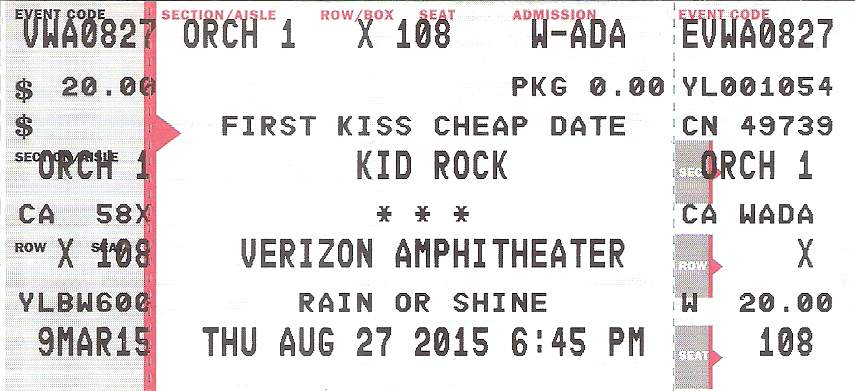
Kid Rock is bringing back the $20 ticket for his Cheap Date tour, which had a show at the Irvine Meadows Amphitheatre (my favorite southern California concert venue) last Thursday night. I’m also a Foreigner fan and, since they were opening for Kid Rock, I would be crazy to not get tickets. So I bought a pair and it turned out to be a beautiful, balmy summer night to attend a concert under the stars.

Kid Rock concert ticket

Foreigner hit the stage without a single member from the original lineup. But they brought the founder of the group, Mick Jones, out from the third song to the end of the show. At over seventy years of age, he’s lost much of his hair and what is remaining is all white. Mick doesn’t move around on the stage with the same energy he used to but his guitar playing was as strong as ever.

Foreigner
Foreigner (without Mick Jones)

The lead singer Kelly Hansen at age 54 is no spring chicken either. But he commanded the stage like someone half his age and must be in great shape to move with the energy he did. He even ended up in the middle of the audience a couple of times, once on a plinth twenty feet over the audience singing Juke Box Hero.

Kelly can still pull off the rocker look (reminiscent of Steven Tyler’s look on this night). But what most impressed me about him was his vocals. Foreigner songs are very difficult to sing but Kelly did not miss a single note. His voice was powerful, not even needing a falsetto for the high notes, and did not weaken a bit by the encore. In fact, Kelly sang even better than Lou Gramm did back when he fronted the band at live shows.

The rest of the band was as tight as can be. They were obviously well rehearsed because the songs sounded almost like the studio versions. The rhythm section kept a strong, driving beat going throughout the show that defied you to keep still. Although every song was at least thirty years old, they sounded fresh and offered just what the Foreigner fans wanted to hear.

Kid Rock
Kid Rock

Kid Rock showed his versatility with his hits ranging from hip-hop to rock to country. Although he sang for most of the show, he played guitar on a couple of songs and also the drums and piano for one song each. Kid even stepped up to the platters for one song and showed that he can scratch with the best of DJs. Kid’s set was very diverse and he sprinkled it liberally with storytelling between the songs. He even spoke at length about aging since he’s not truly much of a kid anymore at 44 years old.

I thoroughly enjoyed Kid Rock’s show. He’s an entertaining performer and his band was solid too. But they weren’t quite as tight as Foreigner. Although it’s a close call, I think Foreigner’s show was even better than the Kid’s. They showed me that even old guys can rock!