I tried to get out of my van in a disabled parking space today but I did not have enough room. The car in the adjacent disabled parking space (displaying a valid Disabled parking permit) had parked about a foot into the access aisle, leaving me about one foot shy of the space I needed.
So I parked on the opposite side of the lot. Coincidentally, an officer from Irvine Police Department parked in the standard space next to me about the same time. So I told him about the car I had encountered and that I had discovered the same car parking the same way in the same spot a few times in the past.
The driver of the car saw me and the officer discussing his car, so he came out (he had a visible disability) to see what was up. I politely explained to him the consequences to other people with disabilities when they encounter a car parked like his. Instead of learning from what I said, he started giving all of the excuses why he parks like that.
So I informed him that it’s a parking violation even if you have a placard. He claimed that a “meter maid” told him he could park like that. I told him that perhaps she was not aware of the law. By that time, the officer had looked it up and read it to the man:
It is unlawful for any person to park or leave standing any vehicle, including a vehicle displaying a special identification license plate … in any area of the pavement adjacent to a parking stall or space designated for disabled persons or disabled veterans that is marked by crosshatched lines and is thereby designated, pursuant to any local ordinance, for the loading and unloading of vehicles parked in the stall or space.
California vehicle code 22507.8(c)
Amazingly, the man kept on making excuses to both me and the officer! Being tired of his excuses, I simply told him that he needed to move his car because it was in violation of the vehicle code. He asked me if I was going to park there and I told him that I would not at that point (I had already parked my van and got out). So he said he did not need to move it if I didn’t need the space.
I explained to him that there are many other people with a van like mine that might need the space he was obstructing. His response was that his condition was deteriorating and that he would need a van like it himself soon. He failed to see the irony in that so I told him that I hoped no one would block him out of a parking space this way when he gets a ramped van in the future.
I was about to leave a store tonight when I encountered a family coming in. The father stood outside holding one of the doors while the rest of the family entered. Seeing me waiting to leave after his family went through, he considerately decided to hold the door for me too, thinking he was being helpful (although I could’ve easily opened the door for myself).
But instead of continuing to hold the door as he did for his family—which would’ve worked out just fine—he must have thought I am four feet wide. He grabbed the second door with his other hand and opened it too. Discovering he was then smack dab in the middle of the doorway, he tried to shift off to one side. There he was, precariously leaning to one side so he could still hold the far door and expecting me to limbo under his outstretched arms (or levitate over him?). Not wanting to sniff his armpits on the way out, I politely suggested that holding just one of the doors would be fine.
The easiest thing for him to do would have been to simply let go of one door and step to the side. But no! He decides to first step inside the door and try to hold it open from there (even though it swung out). Now he was awkwardly stretched out struggling to hold the door open with one arm from the far side. With a wall to the side of the door, he had no choice but to stand at the edge of my path of egress. So there he was expecting me to treat his toes as speed bumps as I waltzed with him through the narrow space he left in the doorway.
Not wanting a lawsuit for flattening his feet, I then suggested he step outside—where he was holding the door for his family in the first place—and hold it from there (what a novel idea!). He begrudgingly obliged me and I was finally able to easily exit. But now he was giving me a look like how dare I be so rude and ungrateful as to tell him how to “help” me.
So here’s the moral of the story: if us people with disabilities need help, we’ll ask for it. And if we ask for help with a door, a wheelchair can easily fit through a single one, so don’t try to hold both of them. But the caveat is that it’s best if you do it from the side to which the door opens and stand out of the way as the wheelchair passes through—for your own sake.
And to the man who I encountered tonight, thank you for at least trying to be helpful. But if you want to dance with me, next time save it for when we meet at the nightclub.
Amazon wants to use drones to deliver packages. That’s a bad idea because their human delivery staff cannot even deliver a package without creating a hazard for their customers. Amazon now has their own logistics team that delivers Amazon Prime packages. They have repeatedly barricaded me inside my own home when delivering packages.
They keep leaving their packages directly in front of my doorway. I have a disability that makes me physically unable to move the package and I use a wheelchair, so I cannot step over or around it. If there were a fire or earthquake on a day they did this, I would be trapped inside. Even though I haven’t had such an emergency yet, Amazon has prevented me from doing things that I planned to do outside on days they have delivered their packages. One time, they left a package directly in front of my door while I was away from home, thereby blocking me from entering my own home when I returned.
It would not be difficult for them to prevent causing such hazards. For example, had they left the packages in the photo above just six inches to the right of the frame of the photo, it would not have blocked wheelchair ingress or egress. They should make it a matter of practice to leave packages to the side of the doorway instead of directly in front of it for all deliveries, not just for deliveries to my home. I’m not their only customer who uses a wheelchair and they never know which home they deliver to has a resident who uses a wheelchair.
When I discovered that Amazon barricaded me inside today, it was actually only one package blocking my doorway. I called Amazon and spent an hour on the phone trying to get them to help me but to no avail. About an hour later, I happened to look outside to discover that the delivery driver was able to return to my home after all, even though the manager I spoke to on the phone told me they could not. But instead of moving the first package out of the way of the door, they just piled a second package on top of it making the situation even worse (as shown in the photo)!
Every time I call Amazon about this issue, they apologize but then try to tell me there’s nothing they can do to help me out. Their driver was able to barricade me inside my home minutes before I called them, so I don’t believe that there’s no way their driver could return and move the package over a couple of inches to the side of my door. It’s not they are unable to help me—they are simply unwilling to. The fact that Amazon has done this to me repeatedly proves that they are also unwilling to train their logistics drivers to not barricade people inside (or outside) their homes, even though it’s no more difficult for a driver to leave a package to the side of a door than it is to leave it directly in front.
This shows a blatant disregard for the safety of their customers on the part of Amazon. I contacted Amazon first so they would have the opportunity to rectify the situation privately and I’m only going public now because they declined to do anything. Hopefully, other customers who use a wheelchair will start complaining about this practice. If enough people make enough noise on social media (like on the Amazon.com facebook page), it will eventually shame them into taking action.
A wheelchair accessible vehicle is meant to provide freedom but that can’t happen if it’s been blocked by careless parking. I want to educate drivers on how to park responsibly around wheelchair accessible spaces. Share this video with your friends and ask that they share it as well to help build awareness about the problem.
Thank you for writing to me about Social Security benefits for people with disabilities. Your correspondence is important to me, and I welcome the opportunity to respond.
I recognize that millions of Americans with disabilities rely upon Social Security benefits to maintain their independence and live heathy, productive lives. According to the most recent figures, 709,509 disabled workers, 12,586 spouses, and 128,447 children in California received Social Security Disability Insurance (DI) benefits in 2014, and more than 1.3 million Californians received Supplemental Security Income (SSI) in 2013. I hope that Congress will act to ensure the long-term solvency of these important programs.
The Old-Age and Survivors Insurance (OASI) retirement program and DI programs are funded largely by revenue from a dedicated payroll tax collected from both employers and employees and paid into each program’s respective trust fund to earn compounding interest. The 2015 annual report by the Social Security Board of Trustees projects that DI trust fund reserves will be depleted by late 2016. In the absence of Congressional action, this reserve depletion would force the Social Security Administration (SSA) to implement an across-the-board reduction in payments to DI beneficiaries by an estimated 20 percent. This would mean that the average monthly DI benefit for July 2015 would be reduced from $1,022.16 to $817.73 per month.
In the past, Congress has routinely reallocated payroll tax revenue between the OASI trust fund that supports retirees and the much smaller DI trust fund, which supports people with disabilities and their families. Congress has reallocated payroll revenue between the trust funds a total of 11 times since 1968. In five instances Congress transferred payroll tax revenue from the DI trust fund to the OASI trust fund. According to a recent analysis by the Center on Budget and Policy Priorities, a reallocation of payroll tax revenue to put the two trust funds on an even footing would expedite the OASI trust fund’s projected reserve depletion by one year (from 2034 to 2033) while extending the solvency of the DI trust fund by an estimated 17 years (from 2016 to 2033).
You may be interested to know that I am an original cosponsor of the “Social Security Earned Benefits Payment Act of 2015” (S.2090), which was introduced by Senator Ron Wyden (D-OR) on September 28, 2015. This legislation would reallocate a part of payroll taxes to the Social Security Disability Insurance trust fund to ensure full benefits are paid through the early 2030s. S.2090 currently awaits action by the Committee on Finance, of which I am not a member.
As you may know, the SSI program provides monthly cash assistance to low-income people who are disabled, blind, or elderly with no real financial assets to help those individuals achieve a basic standard of living. Unlike OASI and DI, the SSI program is funded by general tax revenues from the U.S. Treasury and not Social Security payroll taxes. As such, each year Congress authorizes taxpayer funds that are used to pay eligible SSI recipients. Many SSI recipients who have worked long enough and paid payroll taxes are also eligible to receive Social Security benefits.
Please know that I will continue working with my Senate colleagues to preserve Social Security programs for the millions of Americans with disabilities and their families who count on these vital programs.
Again, thank you for your letter. If you have any additional comments or questions, please feel free to contact my Washington, D.C., office at (202) 224-3841 or visit my website at http://feinstein.senate.gov. Best regards.
Sincerely yours,
Dianne Feinstein
I commend Senator Feinstein for co-sponsoring S.2090. Let’s hope the senate Finance Committee advances the bill to the floor.
That is the question: am I retired or not? I lost my last full-time job over four years ago. Considering myself to be unemployed, I immediately began a concerted job search. I focused on employment because I consider my management skills to be my greatest vocational strength. But at the same time, I also sought contract work to generate some income while seeking employment. If I could build up enough contracts to pay the bills, I was open to becoming permanently self-employed.
Things started out strong. I was getting lots of interest in my résumé and I locked down far more interviews than anyone else I knew seeking employment. I also got a semi-regular part-time job and even some contracts to bring in some income while I was looking for a regular pay check. This work activity helped me to keep my professional chops up. I was also studying for a vocational certificate in Internet marketing. Although I was not working full-time in a permanent role, I was definitely not retired.
The first couple years after losing my job continued like this. I felt like most of my job interviews went real well. Quite a few employers had invited me back for second and even third interviews for some of the positions, making me feel confident I would be extended a job offer. I had also earned the certificate by the end of the second year of my job search, giving me another avenue of employment to pursue. No one had extended me an offer for full-time permanent employment in the first couple years of my job search but I felt like an offer was sure to be forthcoming as long as I kept interviewing at the strong pace I was keeping. I was unemployed but sometimes felt more like I was just under-employed.
After a couple of years had passed since my previous full-time employment, the job interviews began slowing down. I had loosened my standards on the jobs I pursued, willing to take a non-management position in either elearning instructional design or Internet marketing. But I still lined up fewer and fewer interviews. Even my most regular contract work had been taken over by internal employees when the company I had been contracting for was acquired by a larger corporation. But I kept diligently looking for full-time employment and still managed to periodically schedule interviews for some seemingly promising recruitments.
Last month, I hit the four-year mark since losing my last full-time job. By that time, I had interviewed multiple times at a few companies I had been targeting. In a couple of cases, I had even interviewed for the same position that I had interviewed for earlier after it had been vacated again. When I never received a job offer for many positions I was ideally qualified for, I began to think maybe I was facing what I didn’t want to believe I would face from hiring managers—discrimination against me because of my disability, even though it doesn’t impact my performance in the kind of knowledge work I do (my track record of success proves this).
I’ve finally lost the motivation to keep up the search for full-time employment. My efforts seem to be all in vain, so I have tired of making them. Nonetheless, although the bulk of my time is now taken up with leisure activities, I would still much prefer to be working. I find the type of work I do to be more gratifying than my leisure activities. But if I’m not employed and not looking for work, I don’t think I can continue to consider myself unemployed. Although I’m too young to be, it has reached the point that I should start considering myself to be retired.
Coincidentally, I was reading chapter 53 of A Game of Thrones (A Song of Ice and Fire) today and seeing correlations with how things have changed in the USA. The chapter is about Bran, who became paraplegic from a spinal cord injury. Although it’s not as accessible to him as it was before he became paralyzed, Bran has been able to get out and around Winterfell because of a number of accommodations. In this chapter, Bran rises to the level of lord in Winterfell. Yet when he hosted a feast for Lord Karstark, Bran overheard one of Karstark’s sons saying “…sooner die than live like that” and the other referring to him as “broken inside as well as out”: Bran the Broken.
But there’s one place where the ADA, which is supposed to prohibit discrimination and ensure equal opportunity for persons with a disability, has fallen short—in regards to discrimination. As other civil rights movements have discovered, you can’t legislate discrimination away. In 2014, only seventeen percent of Americans with a disability were employed (compared to 64.6% of those without). Most people with a visible disability can tell anecdotes about when people talk to their companion regarding the person with the disability, even though they’re right there together and could answer for him or herself. While many Americans are enlightened about the capabilities of persons with a disability, too many still discriminate against them based on misconceptions and ignorance of what a person with a disability can accomplish. Does anyone remember that president Franklin D. Roosevelt had polio?
The only way to overcome discrimination is to raise awareness about persons with a disability. Recognizing the 25th anniversary of the ADA is one way to do that. Although I would never advocate intentionally doing so, becoming disabled yourself is another way—and it could happen to any of us. Just over 1 in 4 of today’s 20 year-olds will become disabled before they retire. If you don’t have a friend or family member with a disability, don’t be afraid to speak with someone with a disability you happen to meet about what they are capable of and what they’ve accomplished. Most are willing to speak candidly on the topic and you’re certain to be surprised by the stories you hear.
It would be interesting to see what America will be like for persons with a disability in another 25 years. I will not likely be around in 2040 to see it. But I hope those Americans who will be will see even more advancements in the next quarter of a century than in the last.
The biggest challenge using disabled person parking spaces for drivers of wheelchair-accessible vans comes from people parking on the diagonally hatched area adjacent to the spaces. Even though it’s clearly delineated with blue stripes and marked “NO PARKING,” people frequently park there anyway. This can cause serious problems for vans with a ramp or lift on the side!
Car parked entirely on blue stripes
The area is created specifically to allow room to deploy a ramp or lift. Although it might appear like there’s a lot of room, people who use this area need the entire width of it to enter or exit their van. They need at least a couple feet of clear area beyond the end of the ramp to make the turn on or off of it. Parking just a couple of inches onto the blue stripe is often enough to make the adjacent disabled person parking space useless to the driver of the van, even if the adjacent space itself is unoccupied.
This forces the driver to find another more distant disabled person parking space (or to park diagonally across two normal spaces), when looking for parking. But it’s even worse when a wheelchair user parks in a space and returns to their van to find another car pulled into the adjacent space and partially onto the blue stripes while they were away from their van. This prevents them from even entering their van and forces them to wait until the other driver returns to move their car. This is a worst case scenario—the driver of the van could end up waiting around a mall parking structure for hours for the other driver to return if they went to see a movie or dine out.
Even partially on the stripes is a problem
Sadly, the biggest culprits are drivers of cars with a disabled person parking placard. You would think that they would be the most considerate of the special needs of other people with disabilities. Unfortunately, my experience is that cars with a disabled person parking placard park partially on the blue stripes more often than they park fully within the disabled person parking space. I’m not sure why they do—maybe it’s so their car doesn’t get scratched from the opening door of a vehicle next to it (which is a selfish excuse). But doing so to allow room to get a wheelchair out of the car is not a worthy excuse because they can use the blue hatching for that themselves.
This is not a rare occurrence. I encounter this problem almost every time I use a public parking lot. People driving cars with a disabled person parking placard often have a feeling of entitlement to park on the blue stripes but it’s just as much a violation for them as it is for a vehicle without a placard. I usually get push-back when I alert a driver with a disabled person placard to the challenge they have created for me, even though the hatched area is clearly marked that parking on it is prohibited.
Parking on stripes is prohibited for cars with a placard too
So let’s spread the word about this problem. Please tell able-bodied people as well as drivers with a disability how much of a problem they can cause when they park on the blue stripes. Explain that they don’t have to park entirely within the hatching (as in this photo) to be a problem, even parking slightly onto the blue border stripes is enough to be problematic. It’s critical to park a vehicle directly in the middle of any disabled person parking space that has another space next to it.
I went to the store today and asked an employee to reach an item off a high shelf for me. She grabbed it and held it out to me. But she only held her arm out at about 45°, so it was still far out of my reach.
Bear in mind that she was standing directly in front of me. I had my arms outstretched as far as I could but my hands were still a couple inches short of my knees because I was seated. In addition, my toes are at least another six inches farther forward than my knees.
So I asked her to “reach further.” She raised her arm another few degrees which brought the item a couple inches closer to me but still beyond my reach. It was as if she were taunting me, dangling it in front of me but keeping the item just beyond my reach. So I rolled my wheelchair a few inches towards her so I could grab the item but, as I moved towards her, she backed away.
Since I was getting nowhere (figuratively), I stopped and held my arms out again and asked her yet again to “reach further.” She continued holding it out towards me but no closer with this look on her face as if to say, “I’m doing it.” I must have repeated “reach further” at least three times before she finally held it out close enough for me to grab it.
Then I went to the other side of the store to get another item. I asked a different employee to grab it for me. He did it and held it out towards me but still out of my reach. He and I proceeded to go through the same dance I had just danced with his coworker all over again!
Mind you, this trip to the store wasn’t unusual. This happens to me all the time. Do people not know what the words “reach further” mean? Do any of my wheelchair-riding friends encounter the same issue?
Yosemite National Park is a secluded wilderness with sheer granite cliffs and rapid whitewater. These same features that make it spectacularly beautiful might also make you think it’s an inhospitable place to visit for someone with significant mobility limitations. Well, think again because it’s surprisingly accessible to the traveler with a disability.
Yosemite Valley
I recently returned from my first trip to Yosemite since I was a young boy. While there are many different types of disabilities to adapt travel to, I’ll keep this article focused on what a quadriplegic visiting Yosemite will encounter. First of all, it will keep the article shorter but, more importantly, I can speak from my own experience.
The first night, we stayed at the Yosemite Gateway Inn, some 45 miles away from the heart of the Yosemite Valley. By any standards, it’s a quaint and comfortable hotel with reasonable fees, so I would recommend it to anyone staying in Oakhurst (just fourteen miles south of the entrance to the park). But it also offers excellent wheelchair accessible rooms.
The disabled person parking space is adjacent to the room we stayed in. It has a crosshatch area big enough to accommodate a side entry and a ramp to the walkway. The entry to the room has no lip at the threshold and a wide doorway. Inside, there’s plenty of room to maneuver a wheelchair around the beds. The bathroom also has enough space to easily turn a wheelchair around and a large, curbless (or “roll-in”) shower. The sink has no cabinetry beneath it so there is room to roll your knees and lap up underneath. The toilet accommodates a commode wheelchair.
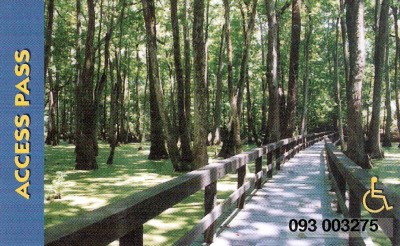
Access Pass
The next morning, we headed to the park. Although most visitors pay a nominal fee for a seven-day permit to access Yosemite, the National Park Service offers an “Access Pass” to visitors with a permanent disability. To qualify, I showed my disabled person parking placard and signed a form affirming my disability. There is no charge for an Access Pass and it permits the holder and a companion unlimited entry to any United States National Park for a lifetime.
Bachelor and Three Graces in Mariposa Grove
Just inside the gate to the park is the Mariposa Grove Welcome Plaza where most people who want to visit Mariposa Grove have to park, then they can catch a wheelchair accessible shuttle or hike a couple of miles up a paved service road to get to the grove. But the park service allows vehicles transporting persons with disabilities to drive the road. Upon arriving at the grove, there are parking and restrooms that are all wheelchair accessible. From the parking area, the half-kilometer-long Big Trees Loop Trail and a section in the Grizzly Giants area are easily navigated in a wheelchair and provide unobstructed views of a grove of Giant Sequoias—the largest species of trees on the planet.
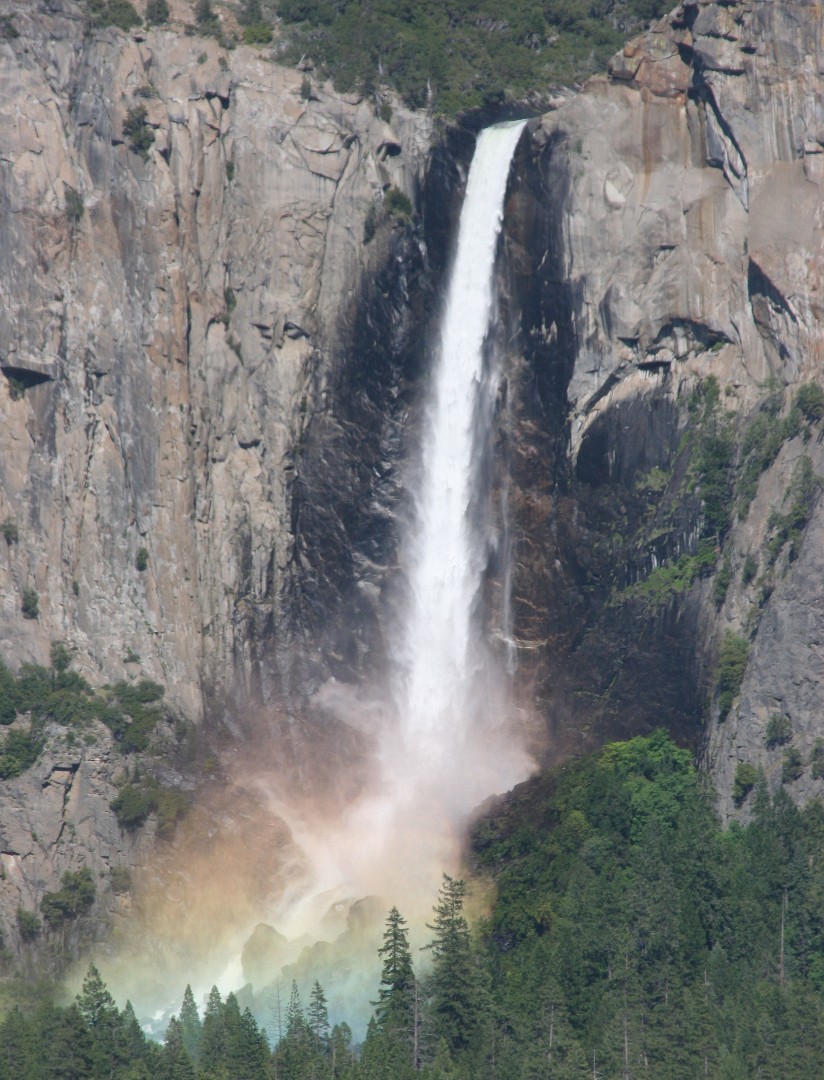
Bridalveil Fall
One of the first landmarks you’ll visit after entering Yosemite Valley is Bridalveil Fall. There is disabled person parking both in the lot near the base of the fall as well as in the lot on Southside Drive. There is an impressive view of the falls from either parking area and, in 2023, the park opened a trail that is wheelchair-accessible right up to the base of the fall.
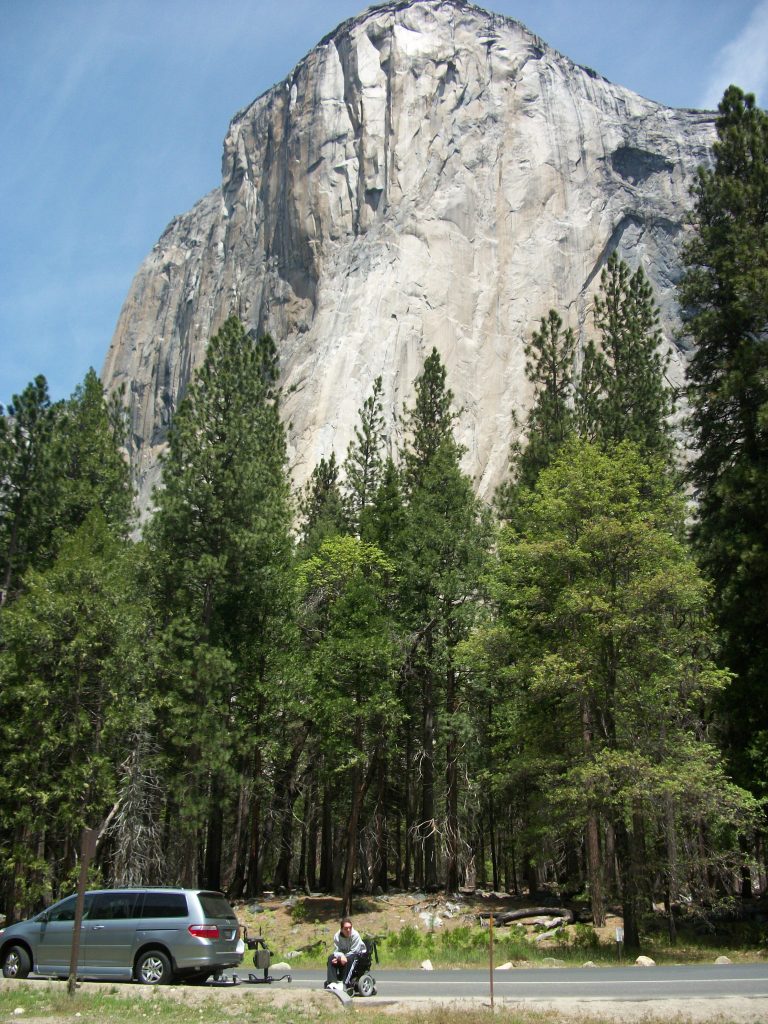
El Capitan
Likewise, there is no wheelchair accessible trail to the base or top of El Capitan. But as the most imposing feature in the Yosemite Valley (and the largest granite face on the planet), there are breathtaking views of it from many accessible locations around the floor of the valley. Park just about anywhere within view of El Capitan and look up…and up and up. Your view of it will be every bit as awesome as that of any able-bodied person in the park.
The Ahwahnee Hotel
We stayed at The Ahwahnee Hotel while in the Yosemite Valley. The wheelchair accessibility of the parking and the entry made me feel good about my choice of lodging. Unfortunately, the room immediately dispelled me of that notion. The beds were luxurious—too luxurious. With thick pillow-tops on both sides of the mattresses, they ended up too high to easily transfer into from a wheelchair. The sink in the bathroom was beautiful English porcelain certain to appeal to the classiest able-bodied guest but the ergonomics were all wrong for me. It was not easy to roll my legs underneath and the top of the counter around it was too high and rounded for someone with a manual impairment to deal with easily. The shower was curbless but it was tight with only front access, so a caregiver cannot easily assist. The toilet was taller than normal, so my commode chair could not access it. Lastly, although the hotel is noted for having beautiful views from almost every room, the wheelchair accessible room we used had no view at all from the windows.
Wheelchair accessible hotel room
In all fairness to The Ahwahnee Hotel, it’s a first-class resort that I would recommend to any able-bodied person visiting Yosemite. Plus, the staff bent over backwards to accommodate me by, for example, bringing a thinner mattress from the lodge up to our room. Nonetheless, I do not recommend the wheelchair accessible rooms at The Ahwahnee Hotel for a quadriplegic.
Yosemite Falls signage
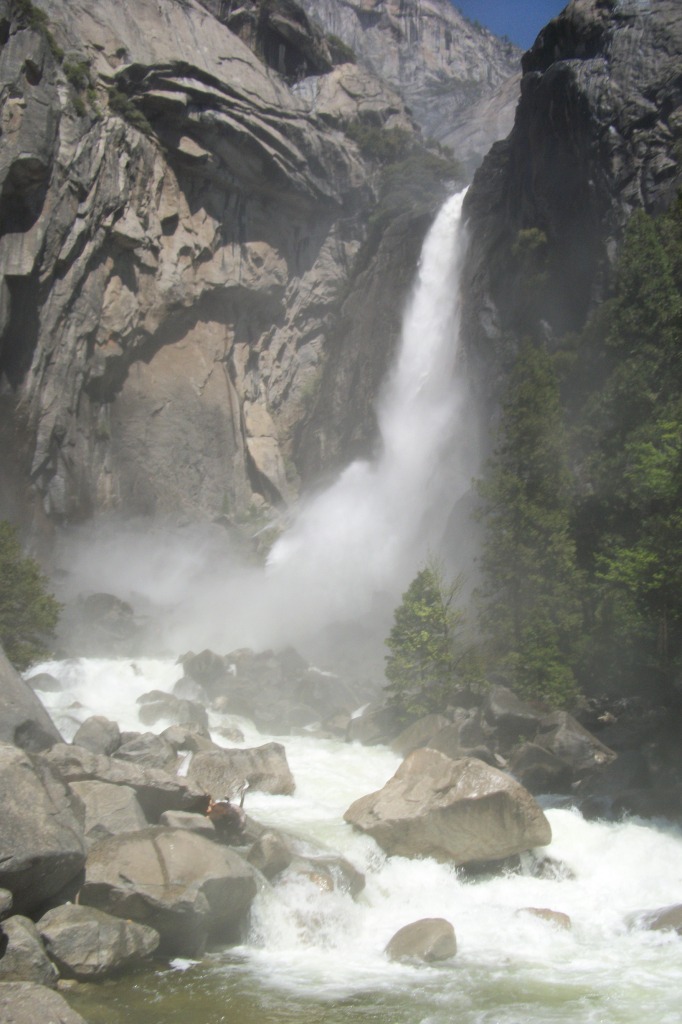
The next day, we visited Yosemite Falls. The signage made it easy to find the wheelchair accessible trail all the way to the base of the fall. The National Park Service clearly went to great lengths to make the trail accessible while still blending in well with the natural surroundings. The force of the falling water is so strong that it creates a brisk wind and heavy mist in the air at the base of the falls, so bring plenty of layers of clothing with you if you chill easily, even on a warm day.
Lower Yosemite Fall
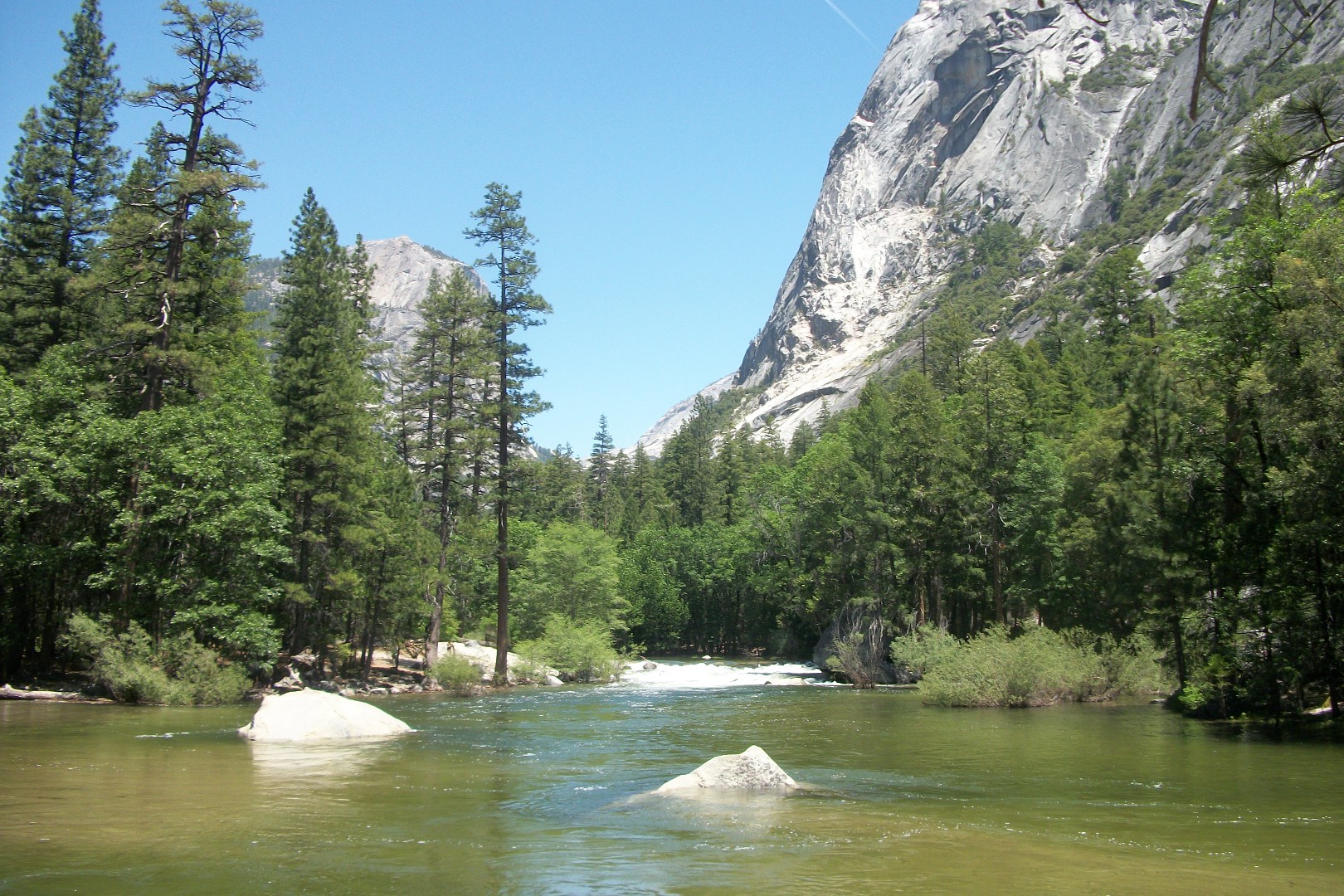
For a close-up view of Half Dome from its base, visit Mirror Lake. The service road to the lake is closed to most traffic but they permit vehicles transporting persons with disabilities to slowly drive it with the hazard lights blinking. At the end of the service road is wheelchair accessible parking and bathrooms. From there, a paved trail traverses a few hundred yards of the lake’s shoreline. Once the paved trail ended, I continued down the foot trail. I was surprised to find that I was able to continue down the Mirror Lake trail well over a half mile in my wheelchair without any assistance. Had I not discovered that the charge on my battery was running low, there’s no telling how much further I could’ve ventured into the woods.
Mirror Lake
On our way out of the park, we drove to Glacier Point. The parking area has wheelchair accessible spaces and restrooms. From there, it’s a quarter mile to the viewpoint overlooking the Yosemite Valley. The signage directs you to the paved trail through the woods with switchbacks so that it’s not too steep for a wheelchair. At the end of the trail, you can roll your wheelchair right up to the edge of the cliff and look down over the Yosemite Valley or have a photo taken of you with Half Dome over your shoulder.
Glacier Point signage
Granted, you can’t go everywhere in Yosemite using a wheelchair. Nonetheless, you can access much more of it than you’d expect, so don’t let concerns about wheelchair access stop you from visiting Yosemite National Park. And the National Park Service deserves recognition for the thought, effort, and cost they’ve obviously put into making it as accessible to visitors as possible.







 The Progressive Zone