An edible marijuana cautionary tale

Yesterday I learned that I can’t overdose on marijuana when I ate ten doses of marijuana in one bite. No, I did not do it intentionally but the story of how it happened is amusing. As it turned out, no harm came from the adventure but it still makes a good cautionary tale about edible marijuana.

When I visited my dispensary last week, they were offering a big sales promotion. I bought an eighth of an ounce of marijuana flowers, which is my preferred form of cannabis consumption. The budtender offered me a marijuana jelly candy for less than a dollar more. Although I enjoy edible marijuana, I rarely buy it because it’s more expensive than in flower form. But at the promotion price, I had her add the jelly candy to my order.

Opened package of a mango & guava flavored Mellow Vibes Jelly with 100 mg of THC
Mellow Vibes Jelly

Bear in mind that the writing seems much smaller and more difficult to read on the package than it does in these photographs to me. Even with my reading glasses on, I had a hard time reading the fine print. Since jellies (or gummies) are usually packaged with ten candies, each candy having ten milligrams of THC, I was surprised to find just one jelly inside this package ─ albeit more than double the size of the gummies I’ve had in the past. So I tried to read the package to find out what I was getting into but the back of the package was even harder for me to read.

Photo of the back of the package of Mellow Vibes Jelly with detailed product info

From what little I was able to read on the front of the package, it looked like it said that it was a “Jelly Single” with ten milligrams of THC. On the back of the package, I was able to make out the word “SAMPLE”. Inside the package, there was only one jelly and it didn’t look like the producer intended it to be broken apart into ten separate doses. So putting all that information together with the under one dollar price, I assumed it was a single dose jelly packaged as a promotional sample.

Since it’s a lazy, rainy weekend, I figured what better way to kick it off than to wake & bake with a mild edible marijuana buzz. I usually eat two or three ten-milligram gummies (an average of 25 mg THC) on the occasions that I eat cannabis rather than vaporizing it. Therefore, I expected to barely feel the jelly I ate yesterday morning since I thought it only had ten milligrams of THC.

Almost an hour later, I was giving up on the idea of feeling the jelly I ate at all. But then I started getting very lightheaded about twenty minutes after that. Since I don’t normally get very lightheaded when I vaporize or eat marijuana, it didn’t occur to me that the jelly could be causing it. Half an hour after that, I started getting very sleepy. Subsequently, I spent the entire day either napping or watching TV and in a complete lethargy until after sunset.

Late in the afternoon, I remembered the jelly I had eaten and put two & two together. I realized that it was probably a much higher dosage of THC than I initially thought it was and was probably also the cause of the unusual feelings I was experiencing. When I finally summoned the energy, I got photographs of my jelly’s package and zoomed in tight enough to clearly read the fine print. That’s when I discovered that the one jelly I had eaten actually had 100 milligrams of THC in it ─ ten times the amount I thought that I had consumed.

The moral of this story is to be cautious when consuming edible marijuana because it’s easy to unknowingly overdose. Overdosing on marijuana will not cause any long-term damage but it will make you useless for the day. And it could freak you out if you didn’t realize that you had consumed a large amount of THC or if you have very little experience with marijuana.

For those who are not familiar with their tolerance of edible marijuana, start with only a ten milligram dose. Regular marijuana users can start with twenty milligrams. But remember that it takes your body far longer to absorb THC you’ve eaten than it does THC that you’ve smoked or vaporized. Allow yourself at least an hour after you eat the first ten-milligram jelly (or two) before considering whether or not you want to eat another. And if you do, allow at least another hour after that before you eat yet another. If you ever do eat thirty milligrams, expect to have a solid buzz for a few hours during which you will not likely get much accomplished.

The lesson I learned yesterday is to also be certain that you know how much THC is in the marijuana you eat. Make sure that you can and do read the entire label clearly. Do not do like I did yesterday and make assumptions about how much THC you’re eating based on a few scattered clues. Lastly, do not drive while you’re intoxicated from marijuana. If you follow these simple rules, enjoying a moderate buzz from edible marijuana can be a pleasant experience.
Alphabet soup

I was recently watching a host interview a drag performer when I heard him mention “LGBTQIA+” people. I was so struck by the absurdity of the initialism that I lost track of his point. This particular initialism seems to be cohort-making to the point of becoming alphabet soup.

Before I say why, I acknowledge that I’m ignorant about many of the cohort’s issues. I welcome your constructive feedback if you can help educate me on the issues. I’ve already admitted to being slept, so it won’t hurt my feelings. But it seems to me that the initialism has watered the cohort down so much that it’s almost meaningless.

I’m old enough to remember when people simply referred to the cohort as “LGB”. This made sense to me because the words the initials refer to have a commonality. They refer to what gender a lesbian, gay, or bisexual person desires having erotic sexual activity with. It’s this second-person perspective that differentiates the cohort from heterosexual people and a person cannot be defined as lesbian, gay, or bisexual without considering the second-person perspective.

But when they appended T onto the original initialism, it seemed to me that they were trying to shoehorn transgender people into a cohort that didn’t fit them. Transgenderism has to do with what gender a person identifies themself as being. The gender with which they desire having erotic sexual activity is irrelevant to the gender the trans person identifies as. This first-person perspective differentiates transgender people from the LGB cohort.

It wasn’t long before the cohort tagged Q at the end of the initialism. Granted, I’m not completely clear on what queer means but at least it returns to the second-person perspective, so it is a better fit with the LGB cohort. But what I am ignorant about is what makes a person queer that cannot be characterized as lesbian, gay, or bisexual, so it seems to be an unnecessary initial to add to the initialism.

Then the initials IA were added. It was so obtuse that I had to look up what they stood for. It makes sense to group intersex people with transgender people because it has the same first-person perspective on gender identity. As with transgender people, the second-person perspective defining lesbian, gay, bisexual (and queer) people is irrelevant to a person being intersex. And being asexual has to do with neither the gender the person identifies as nor with the gender they desire having erotic sexual activity with because they do not desire having sex with anyone.

Finally, the cohort appended a + to the initialism. The + suggests that the cohort is concerned they’re running out of letters. My suggestion is to just stop shoehorning people who don’t really fit into this alphabet soup.

Entitlement is not bad

The word “entitled” has developed an unfair negative connotation. There is nothing inherently negative about it. Merriam-Webster defines “entitled” as having a right to certain benefits or privileges. It’s actually a good thing to have a right to certain benefits or privileges when they are deserved.

How did the word end up with a negative connotation? It happened from people using it improperly. People call other people “entitled” when they actually mean the exact opposite—that they do not have a right to certain benefits or privileges. When someone believes they should receive a benefit or privilege that they do not have a right to, it should be said that they have an undeserved sense of entitlement (“sense” being the operative word) because they inaccurately feel they are entitled.

A classic example of a true entitlement is Social Security benefits. Most workers pay into the Social Security trust fund throughout their professional career via paycheck withholdings and their employer’s contributions to it. Therefore, when a worker becomes eligible for Social Security benefits, they are entitled to receive them.

Nonetheless, there is a viral Internet meme that incorrectly says “Social Security is not an entitlement.” In fact, Social Security is not only an entitlement by the definition of the word (a right to benefits specified especially by law or contract) but also by official designation. The federal government defines an entitlement as:

A Federal program or provision of law that requires payments to any person or unit of government that meets the eligibility criteria established by law. Entitlements constitute a binding obligation on the part of the Federal Government, and eligible recipients have legal recourse if the obligation is not fulfilled. Social Security and veterans’ compensation and pensions are examples of entitlement programs.

United States Senate Glossary

It’s a good thing they are entitlement programs because if the government designated the benefits as “discretionary spending,” they would not be protected. Discretionary spending is subject to the whim of annual appropriations acts and congress has proven completely inept at passing them. That’s why when congress fails to pass one, the government shuts down but beneficiaries continue to receive their Social Security benefits.

So be proud when someone says you are entitled to a benefit or privilege that you have a right to. But if someone says that someone is “entitled” to something they do not deserve, let them know that they are not entitled.

The hypocrisy of impeachment

President Donald J. Trump is impeached by the House of Representatives. He extorted another head of state using the power of his office to get a personal favor. Then did everything he could to obstruct congress’s investigation into the extortion. This should disturb all law abiding Americans. But I am even more disturbed by others’ participation in this impeachment affair.

Like many Americans, I knew what we would be getting in Trump before he was even elected. So none of his criminal acts since he took office have surprised me. He has done pretty much what I expected he would do once he took office.

The parties to this impeachment who have not done what I expected they would do are the Republicans in congress. Perhaps I was naive but I thought that, when faced with important issues of governance, they would do their duty as our representatives and put their country before the Grand Old Party. I assumed that they would realize that allowing a Republican president to trample on the Constitution would come back to haunt them when a Democrat POTUS would later take the office.

I could not have been more wrong. Not only have some of them betrayed their oath of office to uphold the Constitution, almost all of them have. The only Republican who has publicly voiced opposition to Trump’s high crimes, Representative Justin Amash, was literally ejected from the GOP for doing so! Not even retiring Republican congressmen are expressing any objection. And Trump’s former opponents in the Republican presidential primary election who once excoriated him are now the ones carrying the most water for him.

If Republicans opposed the impeachment on principle and with integrity, it would not disturb me. But the GOP is rife with hypocrisy on this matter. Only Trump could do the things he does and not be widely condemned by Republican legislators. Any Democrat doing the exact same things would have been impeached and removed from office already and deservedly so. It’s likely that even any other Republican doing the same things would have suffered the same fate.

It’s not as if there is a lot of disagreement about some of the most condemning facts about the Ukraine scandal. For example, Republicans will all concede that the White House’s memorandum of the July 25 phone call with President Zelensky (AKA the “transcript,” as Trump likes to call it) accurately reflects the call. But imagine if every mention of Trump was changed to President Barack Obama. Then if every mention of the Ukraine was changed to Israel and every mention of Zelensky to prime minister Benjamin Netanyahu. And every mention of Hunter Biden was changed to Mitt Romney’s son. Other than that, leave all the rest of the wording unchanged. Who seriously thinks the Republican congress would have sat on their hands if Obama were to have released such a memo?

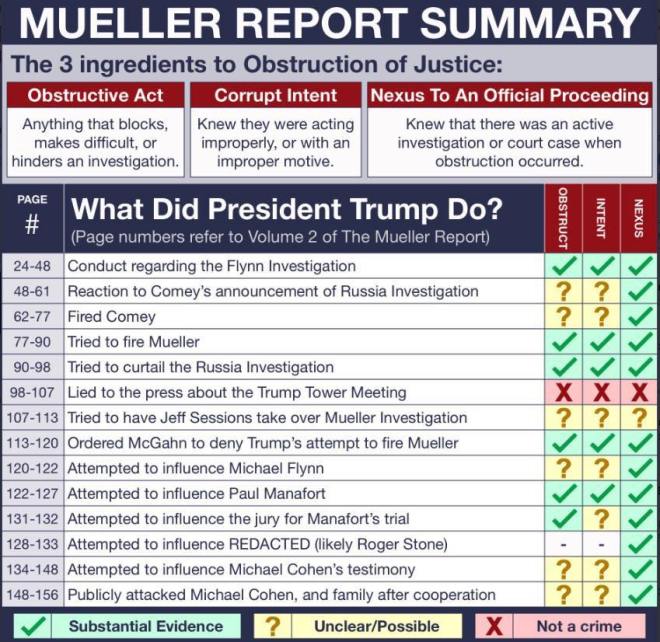
Now imagine if Obama had refused literally every subpoena for documentation and testimony from congress when they opened an investigation into the phone call, which the at-that-time-Republican led congress would have assuredly done. Would Republicans have defended such an action as Obama’s executive prerogative? You can even look back at special counsel Robert Mueller’s Report On The Investigation Into Russian Interference In The 2016 Presidential Election. It cites at least five cases of obstruction of justice by Trump. If Obama and his administration had taken those same actions, would the Republicans in congress have ignored them?

Graphical analysis of fourteen counts of obstruction of justice from Mueller Report
Analysis of fourteen counts of obstruction of justice

We all know the answers to these questions. There’s no way the GOP would have put up with Trump’s high crimes from a Democrat president instead. Congress would be able to curtail Trump if Republicans would behave the same way toward him as they would have toward a President Hillary Clinton. But because they are not, Trump can go on trampling the Constitution with impunity, just as we knew he would. That’s why I’m even more disturbed by the GOP than I am by Trump.

My “ ” pet peeve

It irritates me when I hear a layperson say a particular phrase. But it really gets on my nerve when someone who speaks for a living says it. A professional should know better than to use this spoken phrase but I still hear it all…the…time. The phrase that peeves me to hear is “quote unquote.”

To be clear, I have no problem with people quoting others. It’s the spoken construction of the quote that bothers me. When someone speaks the words “quote unquote” followed by the quotation, it’s confusing and makes the speaker sound dimwitted.

The spoken words “quote” and “unquote” should be used the same way quotation marks are used in writing. When you write a quotation, you write the open quote character followed by the quotation and then end with the close quote character. That way, the reader knows the words between the quotation marks are a direct quote.

But you would never write the open quote character followed immediately by the close quote character then write the quotation. If you did, it would look like the way I intentionally titled this blog as an example of what not to do. The way I titled this blog is confusing and makes me appear to be dimwitted. Instead, you would write the open quote character followed immediately by the quotation then write the close quote character at the end of the quote. It would look like this: My “pet peeve.”

Speaking a quotation should work the same way. Say “quote” in place of the written open quote character, state the quotation, then say “unquote” in place of the close quote character. For example, the correct way to speak the title of this blog would be “my quote pet peeve unquote.”

Of course, you don’t always have to say “unquote.” If it’s clear from the context of the quotation where it ends or if you stop speaking at the end of the quotation, you can drop the word “unquote” from the end of the quotation. But you should always precede a spoken quotation with just the one word “quote.” That’s all it takes to make me unpeeved.

Spectrum deception

Spectrum offered me cable TV service unsolicited by mailing me the flier shown below. It seemed like a reasonable offer for the price they quoted. As you can see in The Spectrum Advantage column of the table showing the terms of their offer, they assured me there would be “No added taxes or extra fees with Spectrum TV.” Confident that Spectrum would charge me no more than $39.99 for cable TV service, I signed up.

Flyer from Spectrum offering cable TV service
Spectrum offer

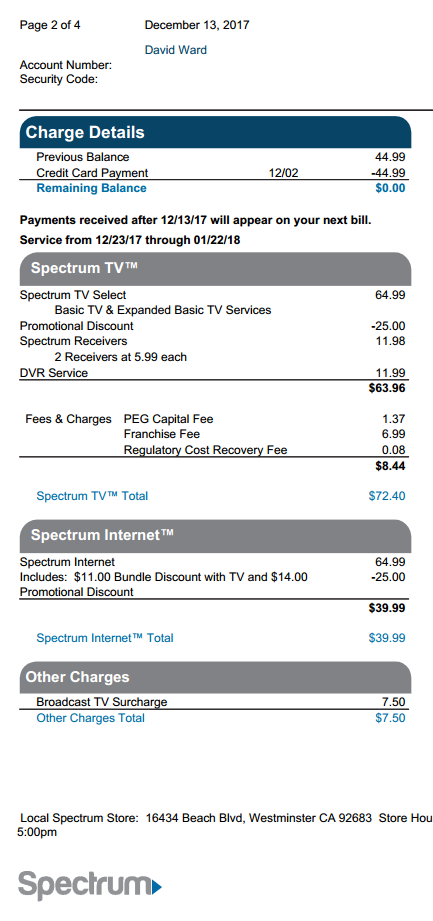
Upon receiving the first bill, I discovered that they were not honoring their offer. Instead of a flat $39.99 for the cable TV portion of my bill (see image below), Spectrum was billing me $55.93 per month! That total does not include the cable boxes and the DVR service—I have no problem with Spectrum charging me additional fees for them. But I do have a problem with them charging me a total of $8.44 in three extra fees under the Spectrum TV service. They also snuck in a $7.50 “Broadcast TV Surcharge.” But calling it a “surcharge” didn’t fool me. The word “surcharge” is literally defined as an extra fee—just the thing Spectrum assured me would not be billed in their offer of “no added taxes or extra fees.”

Cropped page of Spectrum bill showing section with extra fees
Spectrum bill

So I contacted Spectrum’s customer service representative to have them honor the terms they offered me and remove the extra fees from my bill. But all I got was double-talk. Regarding the surcharge, she tried to tell me that “it says added fee and that’s not part of that category. If you remove cable service it will go away.” If you remove cable service and it will go away, that means it is an extra fee specifically on Spectrum TV—exactly what they said I would not have. She was trying to justify not honoring their offer with a fallacy called begging the question. And regarding the other fees, she simply insisted that they could not remove them. I suggested giving me a credit each month to reimburse me for the extra fees if they could not be removed but she refused that suggestion as well.

What Spectrum did is lure me into subscribing for their service with a standard price of $56 per month by telling me they would only charge me $40 for it. But after they connected the service and without any notice, they billed me $56 anyway—the classic bait & switch. It would have been acceptable if I had known going into the deal that they were going to charge me their standard rate but it is not acceptable when the only reason I subscribed is because they approached me unsolicited and offered it to me for $39.99. The moral of the story is that you cannot trust Spectrum to honor the terms they agree on with you.

Even a dog has the sense to get out of the rain

I’m watching NBC News report on Hurricane Irma making landfall near Naples with a life-threatening storm surge on TV and I’m getting irritated. In all fairness, the hypocrisy of the reporting is not limited to NBC.  Just about every major news broadcast is guilty of what I’m watching. Nonetheless, it’s folly and it’s unfair to first responders.

NBC’s Kerry Sanders is reporting from the exposed top deck of a parking structure where the eye of the hurricane is about to make landfall. The wind is blowing so hard that he can barely stay on his feet. Rain is falling almost horizontally and I can see debris flying through the camera shot.

Sanders can barely hear the anchor through his ear monitor and the roar of the storm is almost drowning out Sanders’ voice in the broadcast. But I can hear he’s reporting that the wind is blowing very hard and the rain is falling in a deluge. He’s telling us that the ocean is beginning to rapidly rise onto land and it’s going to be a record storm surge.  It’s very dangerous to be outside, so everyone should have evacuated the area, he says.

Meanwhile, who are the only people cavalier enough to be out in Naples? That’s right—the NBC news crew (and I’m sure other networks’ crews). But we don’t need to see Sanders standing outside in a Category 2 hurricane to realize that the wind is blowing very hard and the rain is falling in a deluge. It’s a hurricane and that’s what they do. NBC has been telling us for days that the storm surge could be twenty feet high when Irma makes landfall in Florida.

The local authorities have already told everyone to evacuate because of the extreme danger in riding out the storm. The authorities warned that anyone who chooses to shelter in place should not expect any response to emergency calls that come in while the winds are high and the waters rising. They have been warning residents that there will be no rescues during the brunt of the storm because doing so risks the life and safety of the first responders. Police officers, firemen, and other emergency workers will need to be healthy to move into the devastation as soon the winds die down.

However, you can bet that Sanders and other news crews would expect immediate treatment in the overburdened hospital if one of them got struck in the head by the debris we can see flying by at over 100 miles per hour. Even though these reporters willfully and knowingly put themselves into this danger just to make a report that is no more informative than it would be from a hardened shelter, they would call 911 if they suddenly found themselves in an emergency situation. And they would want a Coast Guard rescue helicopter to be there if the storm surge took them by surprise and swept them away.

If they were acting responsibly, news agencies would mount unmanned camera feeds out in the storm and have their reporters report the latest news from a safe and secure location. Nowadays, the most up-to-date information comes through telecommunications that would be most reliable indoors out of the storm, so their best reporting would come from such a location anyway. There’s even a possibility that reporters already on location during the storm could obstruct or distract the rescuers’ ingress. Hurricane reporting would actually be more valuable to viewers if the reporters moved in just after the first responders than it is when they are on site before the storm.

The True Gentleman

“The True Gentleman is the man whose conduct proceeds from good will and an acute sense of propriety, and whose self-control is equal to all emergencies; who does not make the poor man conscious of his poverty, the obscure man of his obscurity, or any man of his inferiority or deformity; who is himself humbled if necessity compels him to humble another; who does not flatter wealth, cringe before power, or boast of his own possessions or achievements; who speaks with frankness but always with sincerity and sympathy; whose deed follows his word; who thinks of the rights and feelings of others, rather than his own; and who appears well in any company, a man with whom honor is sacred and virtue safe.”

— John Walter Wayland

Terrorist is the new N-word

Until recently, the provocative media and politicians liked to label a person they disagreed with a “Nazi.” Yes, even President Obama has been accused of acting like a Nazi, as absurd as that is. It didn’t matter if the person they accused of being a Nazi opposes everything the Nazis stood for—it only mattered that the accuser disliked the actions the supposed Nazi was taking. But now there’s a new word that has replaced Nazi: terrorist.

Just like the media and politicians frequently called people who behaved in no way like a Nazi “Nazis,” they have now taken to calling people “terrorists” with no regard to what the word means. Let’s take a closer look at that.

  • terrorist: noun, a person who uses terrorism in the pursuit of political aims
  • terrorism: noun, the systematic use of terror especially as a means of coercion

That means a terrorist must act in a manner that strikes fear into the hearts of the people he or she opposes. And the terrorist must intend for their actions to coerce the people to act according to the terrorist’s political aims.

The latest people that have been accused of being terrorists are the Citizens for Constitutional Freedom who recently occupied a federal wildlife refuge in Oregon. However, this militia has explicitly stated that “we have no intentions of using force upon anyone…this is about taking the correct stand without harming anybody.” Without any threat of force or harm against the people, the Citizens for Constitutional Freedom lack one critical element to be terrorists: terror.

Robert Lewis Dear, who shot a dozen people in a Planned Parenthood facility, killing three, last November is a terrorist. He intended to coerce Planned Parenthood into ceasing abortions by terrorizing its staff and consumers. Syed Rizwan Farook and Tashfeen Malik, who killed fourteen people at a San Bernardino county holiday party last month, are terrorists. They intended to coerce “infidels” into converting to Islam by terrorizing people who were presumably Christians (or, at least, not Muslims). The Citizens for Constitutional Freedom and the Bundy brothers who lead them are not terrorists—they are traitors.

Oregon militants: Patriots or Owl Qaeda?