This will be interesting to watch unfold. First of all, how many other revolutions have we seen where the revolutionaries are not in large part members of some structured organization that could present potential leadership? It seems the Egyptians have not yet coalesced en masse behind any significant potential chief executive, political party, or existing government structure (other than their respect of their army).
Secondly, how many other revolutions have we seen where the revolutionaries overthrew a stable government using entirely peaceful methods? Not a single weapon was used by revolutionaries to force Mubarak from office. They used nothing more than the sheer collective will of the people—the truest form of democratic revolution. I think this revolution is now in uncharted waters, so it could end up just about anywhere.
Lastly, few would disagree that Web 2.0 technologies played a critical role in facilitating this revolution. Now that we have a successful proof of concept for a telecommunications-based revolution, it makes me wonder what we will see happen in other oppressive states in the Middle East these next few months. I’ve read that the youth in Iran—a substantial segment of the population—aspire to a more Western-style society…
I call this blog The Progressive Zone because I like to think of myself as a progressive person. Unfortunately, when some people hear the word “progressive,” they equate it to being liberal. My conception of progressive is neither liberal nor conservative—or maybe it’s a little of both.
When Juan Enriquez shares mindboggling science, he explores a number of examples of what I consider to be “progressive.” Watch Enriquez’s TED presentation then read the rest of this post.
As you saw, none of the science Enriquez shares is “liberal” in the negative sense some hold of socialist government or late-term abortions and the like. In fact, the economic concept presented at the beginning is actually fiscally conservative. But no one would deny that both the fiscal approach and the science is progressive—at least according to my concept of progressivism.
Enriquez paints a picture of the kind of future we will get if progressive thought is used to get us there. The question it raises is, do you find this kind of world scary? There are likely many people who would be intimidated by the thought of humankind becoming Homo evolutis. After living more than twenty-five years in a paralyzed body, I find it exciting!
No, that’s not a typo—I didn’t mean an epic “tale.” It was truly an epic ale I drank last night: the Stone Vertical Epic ale. As epic as this ale is, I’d never heard of it until last night.
Eric, the owner of Addison Homebrew Provisions, brought a bottle of the 10.10.10 bottling of the series to my home. The series of Vertical Epic is brewed over the course of ten years and designed to be cellared for a vertical beer tasting sometime after December 12th, 2012. I was very fortunate to be there when Eric prematurely popped the cap.
Stone Vertical Epic
I’m a big fan of Stone Brewing Co., the brewer of what is in my opinion the best commercial pale ale on the market. Nonetheless, the 10.10.10 Vertical Epic exceeded even this high bar. In fact, it’s probably the best beer commercially brewed in the United States that I’ve drank in years.
It pours slightly opaque with an almost golden color. The head had dissipated almost completely by the time I got the glass but the ale still had a pleasant nose to it. I’ll spare you the comparisons to all of the foods that aren’t put into beer which connoisseurs claim to smell—I’m pretty sure I smelled malt, hops, yeast and some other stuff. The aroma was mild enough that it wasn’t a spoiler for what I was in for when I tasted the Vertical Epic.
Stone says they brewed the beer to fit the strong Belgian golden ale style. This boded well for me since Belgian ales are my favorite styles of beer. The Vertical Epic did have the essence of a Belgian ale but there was something else going on that I couldn’t quite place at first. Whatever it was, it was delicious from the first swig, while the ale was still cold.
So what “else” was there? For one, Stone says they added chamomile during the whirlpool stage. I can’t say that I tasted it but I could faintly smell it once I was made aware of it. But what “else” was probably most significant about the 10.10.10 Vertical Epic is that Stone added a juice blend of Muscat, Gewurztraminer, and Sauvignon Blanc grape varietals in secondary fermentation. When I was told this, I realized that ironically the flavor that really makes this beer great is wine. The reason I couldn’t initially peg the Epic style is because it’s essentially…a wine beer (if you never heard of a “wine beer,” it’s because I just coined the term).
I normally take my time drinking a fine ale—particularly when it’s upwards of ten percent alcohol, like the Vertical Epic—but I found myself drinking it like a session beer simply because it was so good. I had to refill my glass to be able to taste it after it warmed some and, yes, it was every bit as enjoyable and perhaps more complex as when it was cold.
While you can let the 10.10.10 Vertical Epic warm, I recommend against letting it age ‘til 12/12/2012. In my opinion, it lacks the foundation that makes an ale age well that much longer. The flip side of that coin is that it will likely be the best beer you’ll drink this year, so don’t pass up the opportunity to drink the Stone Vertical Epic ale if you can find it.
Normally I prefer brunettes but tonight I’m making an exception for a delectable Belgian blonde. This blonde comes from a monastery in Belgium called Maredsous. She’s a true abbey ale, with 6% alcohol by volume.
The Maredsous Blonde pours up with a thick, foamy head, proudly displaying a few pockmarks from the bigger bubbles popping. She leaves a heavy lacing on the glass as I drink her down. The head releases a sweet, grassy bouquet with a hint of sharp cheddar. She also creates a great sensory experience as the foam carries the ale across the tongue.
The ale is golden in color with a faint murkiness. As I drink her in, the distinctive flavor of the Belgian yeast steps out at me. But it’s well balanced with the malting and bitterness of the hops. The malt leaves a slightly waxy mouthfeel. The mild European hops linger on the palette. Maredsous reminds me of a Belgian wit I cut my teeth on but without the spiciness. This allows the four flavors of a basic beer to shine in this blonde.
And shine they do! The Maredsous Blonde is one of the most enjoyable beers I have drunk in quite a while. As she warms, she is smoother than ever. Now I’m done with her—all that’s left is the traces of her white head lacing the glass.
This has supporters of the proposition in an uproar, claiming that Walker denied the people of California their free will. It’s ironic that the California Marriage Protection Act itself denies an entire class of people their free will to marry. Of course, Proposition 8 supporters would argue that all it does is to explicitly define “marriage” in the state’s constitution as it has been defined for millennia.
In fact, polygamy—one of the more ancient practices—was long considered a legitimate marriage, both in religions and in society. It was not uncommon for a marriage between an adult and a girl in her early teens to be recognized without controversy. Because the Confucian philosophy dictated that Chinese marriage brings together families of different surnames, it was not considered incestuous to marry one’s maternal relative, and families would intermarry from one generation to another.
In modern marriage, neither religion nor moralities have any relevance, at least insofar as the state of California is concerned. Walker made this case in his ruling when he wrote the following clause:
Marriage in the United States has always been a civil matter. Civil authorities may permit religious leaders to solemnize marriages but not to determine who may enter or leave a civil marriage. Religious leaders may determine independently whether to recognize a civil marriage or divorce but that recognition or lack thereof has no effect on the relationship under state law.
He was also careful to recognize that overturning the law in no way impinges on anyone’s religious freedoms:
Proposition 8 does not affect the First Amendment rights of those opposed to marriage for same-sex couples. Prior to Proposition 8, no religious group was required to recognize marriage for same-sex couples.
A marriage in a California church, temple, or synagogue is not legally recognized if the state has not licensed the couple to marry. A legal marriage licensed by the state is valid even if there has been no religious ceremony. From the perspective of the state of California—which is the only jurisdiction of the California Marriage Protection Act—marriage is simply a legal status of two consenting persons, with the associated rights and responsibilities prescribed by law.
Furthermore, within the scope of authority of Proposition 8, marriage is a state matter. California is obligated to execute state law only to the extent that it is constitutional under the United States Constitution. That constitution happens to have an equal-protection clause—Amendment XIV—that prohibits discrimination based on sexual orientation. Judge Walker wrote that “Proposition 8 fails to advance any rational basis in singling out gay men and lesbians for denial of a marriage license.” Proposition 8 reflected the will of the people of California…to enact an unconstitutional law. For that reason, it should not stand.
Yosemite National Park is a secluded wilderness with sheer granite cliffs and rapid whitewater. These same features that make it spectacularly beautiful might also make you think it’s an inhospitable place to visit for someone with significant mobility limitations. Well, think again because it’s surprisingly accessible to the traveler with a disability.
I recently returned from my first trip to Yosemite since I was a young boy. While there are many different types of disabilities to adapt travel to, I’ll keep this article focused on what a quadriplegic visiting Yosemite will encounter. First of all, it will keep the article shorter but, more importantly, I can speak from my own experience.
The first night, we stayed at the Yosemite Gateway Inn, some 45 miles away from the heart of the Yosemite Valley. By any standards, it’s a quaint and comfortable hotel with reasonable fees, so I would recommend it to anyone staying in Oakhurst (just fourteen miles south of the entrance to the park). But it also offers excellent wheelchair accessible rooms.
The disabled person parking space is adjacent to the room we stayed in. It has a crosshatch area big enough to accommodate a side entry and a ramp to the walkway. The entry to the room has no lip at the threshold and a wide doorway. Inside, there’s plenty of room to maneuver a wheelchair around the beds. The bathroom also has enough space to easily turn a wheelchair around and a large, curbless (or “roll-in”) shower. The sink has no cabinetry beneath it so there is room to roll your knees and lap up underneath. The toilet accommodates a commode wheelchair.
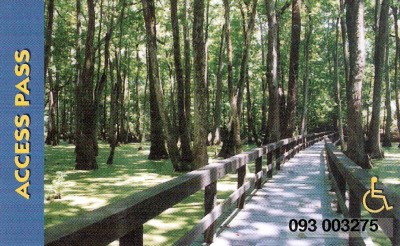
Access Pass
The next morning, we headed to the park. Although most visitors pay a nominal fee for a seven-day permit to access Yosemite, the National Park Service offers an “Access Pass” to visitors with a permanent disability. To qualify, I showed my disabled person parking placard and signed a form affirming my disability. There is no charge for an Access Pass and it permits the holder and a companion unlimited entry to any United States National Park for a lifetime.
Bachelor and Three Graces in Mariposa Grove
Just inside the gate to the park is the Mariposa Grove Welcome Plaza where most people who want to visit Mariposa Grove have to park, then they can catch a wheelchair accessible shuttle or hike a couple of miles up a paved service road to get to the grove. But the park service allows vehicles transporting persons with disabilities to drive the road. Upon arriving at the grove, there are parking and restrooms that are all wheelchair accessible. From the parking area, the half-kilometer-long Big Trees Loop Trail and a section in the Grizzly Giants area are easily navigated in a wheelchair and provide unobstructed views of a grove of Giant Sequoias—the largest species of trees on the planet.
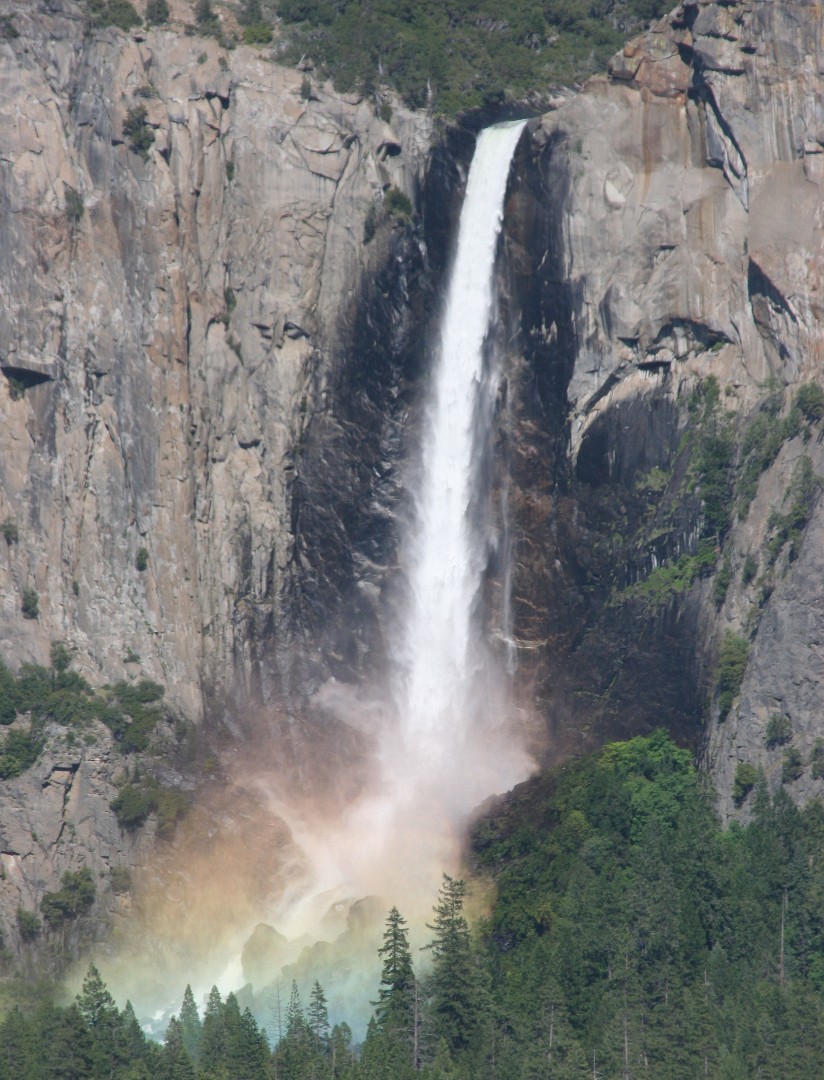
Bridalveil Fall
One of the first landmarks you’ll visit after entering Yosemite Valley is Bridalveil Fall. There is disabled person parking both in the lot near the base of the fall as well as in the lot on Southside Drive. There is an impressive view of the falls from either parking area and, in 2023, the park opened a trail that is wheelchair-accessible right up to the base of the fall.
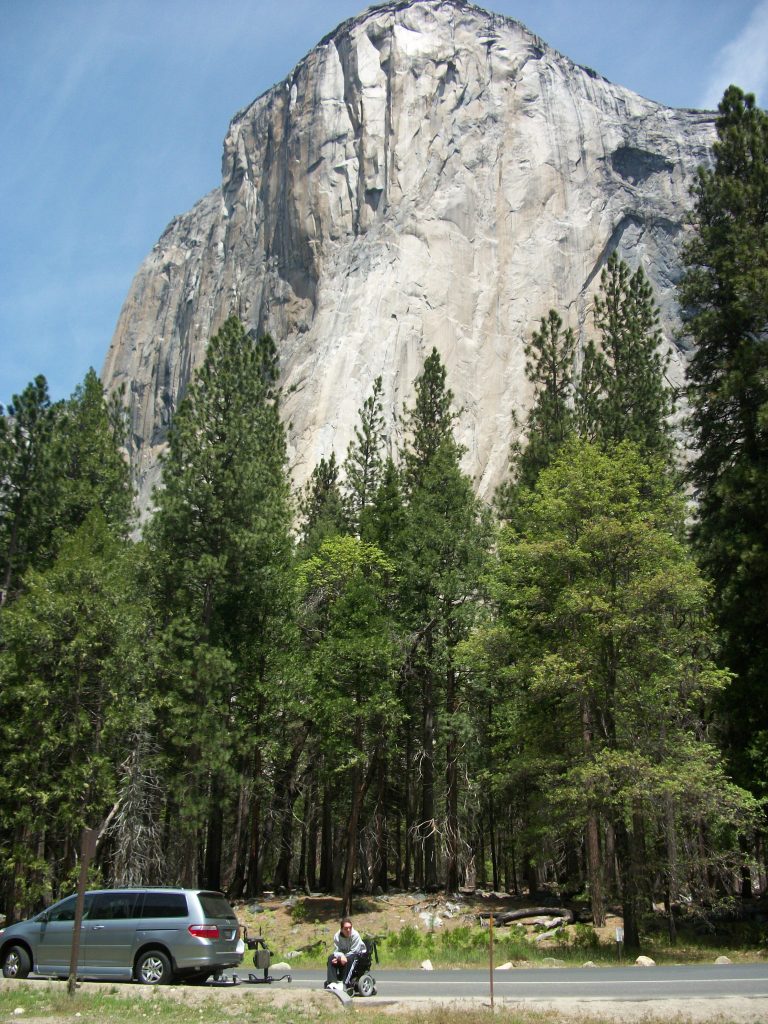
El Capitan
Likewise, there is no wheelchair accessible trail to the base or top of El Capitan. But as the most imposing feature in the Yosemite Valley (and the largest granite face on the planet), there are breathtaking views of it from many accessible locations around the floor of the valley. Park just about anywhere within view of El Capitan and look up…and up and up. Your view of it will be every bit as awesome as that of any able-bodied person in the park.
The Ahwahnee Hotel
We stayed at The Ahwahnee Hotel while in the Yosemite Valley. The wheelchair accessibility of the parking and the entry made me feel good about my choice of lodging. Unfortunately, the room immediately dispelled me of that notion. The beds were luxurious—too luxurious. With thick pillow-tops on both sides of the mattresses, they ended up too high to easily transfer into from a wheelchair. The sink in the bathroom was beautiful English porcelain certain to appeal to the classiest able-bodied guest but the ergonomics were all wrong for me. It was not easy to roll my legs underneath and the top of the counter around it was too high and rounded for someone with a manual impairment to deal with easily. The shower was curbless but it was tight with only front access, so a caregiver cannot easily assist. The toilet was taller than normal, so my commode chair could not access it. Lastly, although the hotel is noted for having beautiful views from almost every room, the wheelchair accessible room we used had no view at all from the windows.
Wheelchair accessible hotel room
In all fairness to The Ahwahnee Hotel, it’s a first-class resort that I would recommend to any able-bodied person visiting Yosemite. Plus, the staff bent over backwards to accommodate me by, for example, bringing a thinner mattress from the lodge up to our room. Nonetheless, I do not recommend the wheelchair accessible rooms at The Ahwahnee Hotel for a quadriplegic.
Yosemite Falls signage
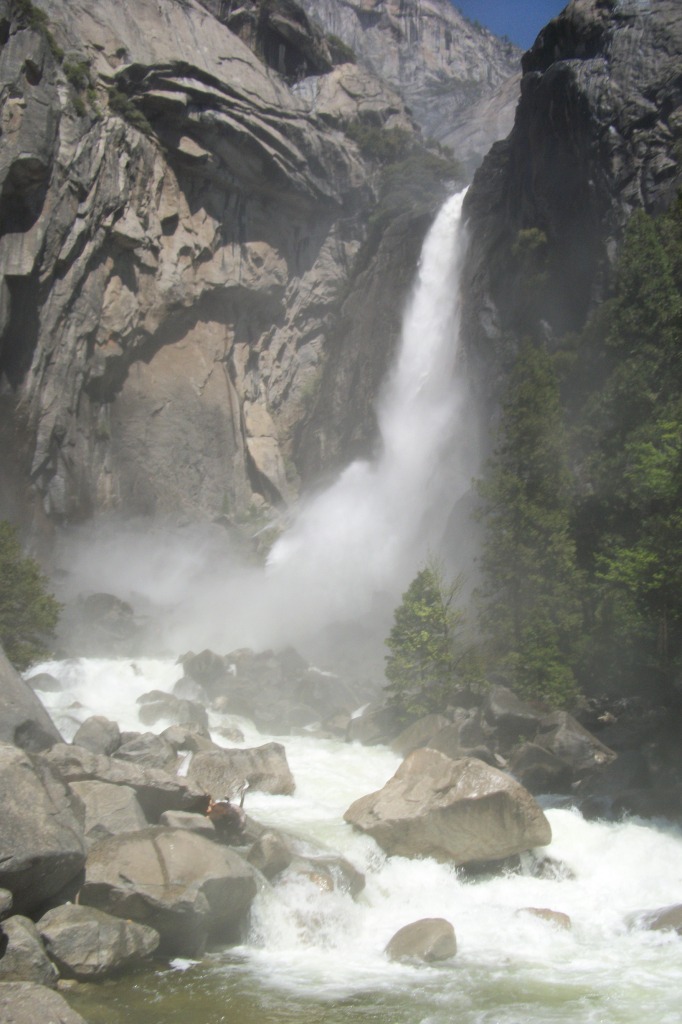
The next day, we visited Yosemite Falls. The signage made it easy to find the wheelchair accessible trail all the way to the base of the fall. The National Park Service clearly went to great lengths to make the trail accessible while still blending in well with the natural surroundings. The force of the falling water is so strong that it creates a brisk wind and heavy mist in the air at the base of the falls, so bring plenty of layers of clothing with you if you chill easily, even on a warm day.
Lower Yosemite Fall
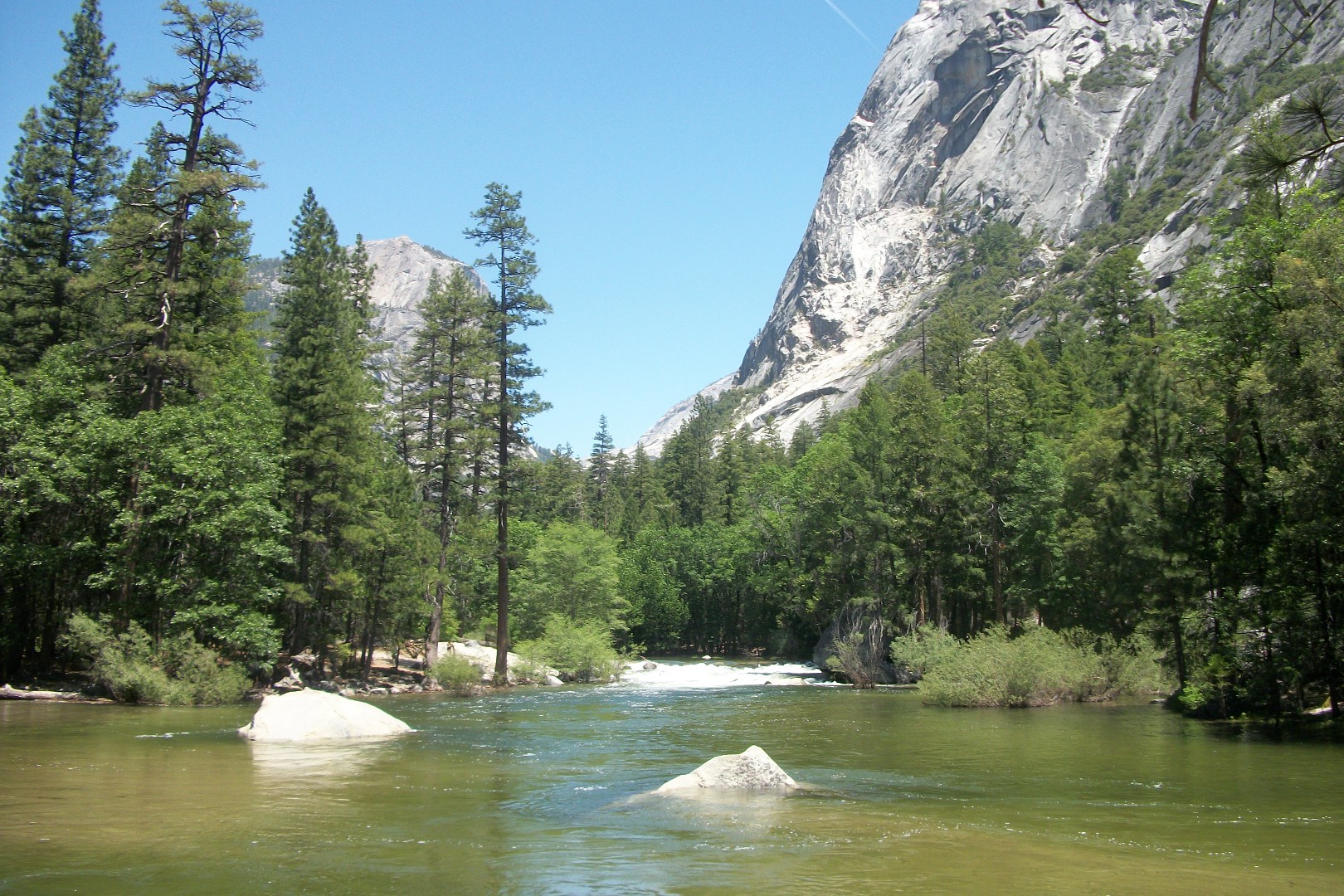
For a close-up view of Half Dome from its base, visit Mirror Lake. The service road to the lake is closed to most traffic but they permit vehicles transporting persons with disabilities to slowly drive it with the hazard lights blinking. At the end of the service road is wheelchair accessible parking and bathrooms. From there, a paved trail traverses a few hundred yards of the lake’s shoreline. Once the paved trail ended, I continued down the foot trail. I was surprised to find that I was able to continue down the Mirror Lake trail well over a half mile in my wheelchair without any assistance. Had I not discovered that the charge on my battery was running low, there’s no telling how much further I could’ve ventured into the woods.
Mirror Lake
On our way out of the park, we drove to Glacier Point. The parking area has wheelchair accessible spaces and restrooms. From there, it’s a quarter mile to the viewpoint overlooking the Yosemite Valley. The signage directs you to the paved trail through the woods with switchbacks so that it’s not too steep for a wheelchair. At the end of the trail, you can roll your wheelchair right up to the edge of the cliff and look down over the Yosemite Valley or have a photo taken of you with Half Dome over your shoulder.
Glacier Point signage
Granted, you can’t go everywhere in Yosemite using a wheelchair. Nonetheless, you can access much more of it than you’d expect, so don’t let concerns about wheelchair access stop you from visiting Yosemite National Park. And the National Park Service deserves recognition for the thought, effort, and cost they’ve obviously put into making it as accessible to visitors as possible.
People who do not believe in evolution had some seemingly sound arguments against the theory. Unfortunately, those people now have two fewer legs to stand on. Two arguments commonly used against evolution have now been refuted.
One of the widely known arguments is the watchmaker analogy. It says that the complex inner workings of a watch could only come to be through the act of an intelligent designer. Therefore, as with a watch, the complexity of a given life form could only be created by intelligent design.
It turns out that evolution is a blind watchmaker after all. A doctor of molecular neuroscience wrote a computer program that emulates the process of natural selection using the component parts of a watch. He found that a functioning watch could, in fact, evolve from its independent parts without any intelligent design.
Another argument commonly posited is that no fossil evidence has been discovered that shows one species evolving into another. People who ascribe to this argument postulate that, considering the countless species that have existed on this planet, there must be abundant fossil evidence of this speciation if evolution really occurred. Since there is no such evidence, there has been no evolution.
It was long assumed that man had to look into fossil history for evidence of speciation since written history is too short to observe a species splitting into two separate species. It turns out that mankind need not look back tens of thousands of years for evidence of speciation—they need only to look to the Galapagos islands. The birth of a new species has now been witnessed by scientists. A husband-and-wife team of biologists have witnessed that elusive moment when a single species of Galapagos finches split into two separate species within what turned out to be a surprisingly short period of time.
Proponents of Intelligent Design now need to postulate two new arguments against evolution.
My friend made a post to his Facebook where he attempted to list every concert he’d been to. He tagged me (and some of his other friends), challenging me to list every one that I had been to. Considering that I’ve been to hundreds of concerts over the span of more than three decades, there’s no possibility that I could list every concert I’ve been to. So instead I decided to post the dozen most notable concert experiences I’ve had.
The Police Approx. 1981 Sunrise Musical Theater The first time I saw The Police in concert was on the Zenyattà Mondatta tour. What made this concert particularly memorable was the back seat of my car going up in flames on the drive up to the show. You can read all about the wild ride here. I saw them again over a quarter of a century later when The Police reformed for a reunion tour and you can read about that in We don’t need no stinking badges.
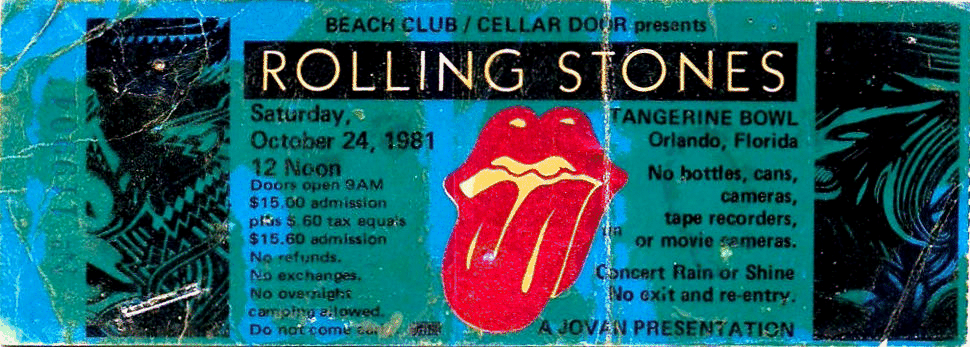
Rolling Stones October 24, 1981 Tangerine Bowl John and I drove all the way from Miami to see The Stones. The Tattoo You tour was the first of about a dozen “farewell tours” The Stones have played. The Stones had a band called Van Halen (Perhaps you’ve heard of them?) open for them. It was the last time Van Halen opened for another band. Personally, I liked Van Halen’s show better than The Stones’. David Lee Roth had even better moves than Jagger.
The US Festival September 3-5, 1982 Glen Helen Regional Park This was the rock festival to rival Woodstock. It was held in an immense natural amphitheater with nothing less than the San Bernardino Mountains and the San Fernando Mountains backdropping a huge stage. It’s impossible to sum up three sunny days with a million people and fifteen major acts in a paragraph. All I can say is, the US Festival will forever remain unequaled as the greatest concert experience of my life. If you can handle the full uncensored story, read My 1982 US Festival Trip.
The Who October 29, 1982 Los Angeles Memorial Coliseum It was just me, Scott, and 100,000+ of our closest friends in the Coliseum with festival seating and The Clash. What, you ask, is so notable about that? The Who headlined! Enough said.
Supertramp September 25, 1983 Irvine Meadows Amphitheater Mike and I were fortunate enough to sit in the twelfth row for this concert. The Meadows was a beautiful, open-air amphitheater built on the side of a hill. Because of this theater’s great sound reinforcement, we could really appreciate the layered vocal harmonies, percussion, and woodwind instruments of a Supertramp show. With a setlist eighteen songs long, they played for hours and their performance was spotless. They seemed to be on an emotional high. During the intermission, we found out why. It turned out to be the last show that founding member Roger Hodgson played with the band, so they presented him with a gold watch.
The Tubes Approx. 1986 Ceasar’s Tahoe How do you explain a Tubes show to someone who’s never seen one? To say it’s outrageous and over-the-top doesn’t begin to do it justice. The stage was set with over-sized props and beautiful women in skimpy costumes dancing all over. Fee Waybill has an amazing imagination and boundless creativity, so the show was a feast for the eyes. Yet the musicianship of the band is so excellent that the music easily holds its own with the stage production. Not being gamblers, Mike and I went to the show looking for a way to pass the evening at South Lake Tahoe after a day of great snow skiing. We lucked out and were seated almost within an arm’s length of the stage.
Eagles May 29, 1994 Irvine Meadows Amphitheater This show turned out to be opening night of the Hell Freezes Over tour—the first time the band had played for a paying audience in fourteen years. There was this atmosphere of anticipation and build-up for this show that the band fed off of. Subsequently, the Eagles were in particularly rare form. By this time, I was using a wheelchair but, there under the stars on a beautiful summer night with my bro Jim, the wheelchair-accessible seating had a great view.
Elton John and Billy Joel Approx. 1997 The Forum Elton John and Billy Joel co-headlined on the Face to Face tour. I had previously seen Billy Joel in concert but had not seen Elton live, so Jim and I decided it was again time to see a show together. We were able to get the wheelchair seating near the left side of the stage in the first row of the upper-level, so it’s unobstructed. There was a Jumbotron directly in front of us, PA speakers on either side, and the stage laid out below us. Elton John opened the show with his band, playing a rocking set. Then the crew brought out a second grand piano and Billy Joel joined him on the stage. After another long set, Elton retired backstage and Billy Joel played a set with just his band. Finally, Elton rejoined him for a long encore.
Santana October 14, 2005 Dignity Health Sports Park I had been to numerous soccer games at the Home Depot Center but I was unfamiliar with the wheelchair seating for concerts. When Santana was going to play there, I decided to find out. Imagine my surprise to discover I could sit in the front row and my greater surprise to find out there was still wheelchair-accessible seating available! With seats that close, I had to buy tickets, even though I had already seen Santana live three times previously. Since the soccer field (where the stage is set) is below street level at the Home Depot Center, it turned out the only way to get there in a wheelchair is to take a freight elevator which opens up backstage. From there, Michael and I found our way to the field and over to the wheelchair seating area situated directly in front of the stage. After the show, we had to go backstage again to leave and were fortunate to encounter some of the band members there (although we did not get to meet Carlos).
Roger Waters June 15, 2007 Irvine Meadows Amphitheater For the full story on this show, read When pigs fly!
For every show listed above, I’ve probably seen a dozen other concerts whose story has yet to be written. They include acts like Queen, U2, Simon & Garfunkel, Yes, the Doobie Brothers, Rush, and Steely Dan—some of them numerous times. In fact, I’m sure there are many acts I’ve seen that I don’t even remember. So to keep things simple, I’ll end my list here with just a dozen of the most memorable concerts.
Where is the change President Obama spoke of in his campaign? It certainly is not in the form of the health care reform bills going through congress right now. I still have hope that the bill that finally gets signed into law is real health care reform but things are moving in the wrong direction right now. The problem is that insurance companies are still at the core of the various bills being developed right now.
We are the only advanced country in the world that has chosen to leave health care to the tender mercies of a panoply of for-profit businesses, whose purpose is to maximize income and not to provide health. And that’s exactly what they do.
Dr. Angell was referring to Obama’s position that Americans who do not get health insurance from their employers be mandated to purchase it under the health care reform plan. She says that by so doing, “We’re going to deliver the private insurance companies a captive market…And they love that.”
In fact what we need to do is eliminate the market—at least from the insurance companies—by creating a single-payer plan. Insurance companies deliver no value to patients or recipients of health care whatsoever in the current health care system. All they do is generate costs—almost one-third of what Americans are currently paying for health care goes to administration by health insurance companies.
Opponents of a single-payer system say that patients would get no choice in their health care. It would be completed dictated by the government. But the evidence contradicts this assertion. Dr. Angell goes on to point out about this claim:
It’s phony, in the sense that Medicare is a single-payer system, embedded within our larger market-based system. You have totally free choice of a physician in Medicare. You don’t in most employer-sponsored private plans. Canada, totally free choice of doctors. So, this is simply not true.
Opponents also claim that a single-payer system would lead to rationing. But the fact is that it’s our current “free market” system that rations health care by providing it to the insured and denying it to the poor and uninsured. In fact, even middle class families are falling victim to the status quo: sixty percent of bankruptcies are caused by health problems. Dr. Angell says:
If we continue to spend what we do, right now, on health care, but had a system that distributed it according to medical need, there would be no rationing. And if we held it at that cost, there would never be any rationing. So, it’s simply not right. The problem is not the money, it’s the system.
It’s not easy going through life with a disability. Fortunately, people with disabilities get an occasional privilege. One of them is the use of disabled person parking spaces. It helps make one small aspect of life a little easier.
Nonetheless, the privileges need to be respected. When taken for granted, the person doesn’t appreciate the privilege. When a person has a sense of entitlement to privileges, it leads those without them to begrudge the privileged. So even a person with challenges in life and few privileges should take care not to abuse them.
Shatney had just bought a new car, so he did not have his disabled person plates yet. But Shatney also qualifies for a disabled person placard. He could use the placard until the plates arrived. Instead, Shatney felt that having his wheelchair in the back seat and hand controls for driving entitled him to use the disabled person parking space, even though the law said otherwise.
The law says that the disabled person placard must be displayed when parking in a disabled person parking space. In fact, it says that the person must show the registration for the placard when a law officer makes the request. The law does so for a couple of reasons. One is that abuse of disabled person placards is rampant. Another is that many people have “invisible disabilities” where you cannot see that they have a disability by observing them walking from their car parked in a disabled person parking space.
There is no exception in the law for people with wheelchairs or for having hand controls in their car. If there were, some people without a disability would find yet more ways to take advantage of disabled person parking. The law protects the privilege of the driver or passenger with a disability. It should be respected by the beneficiaries of the privilege.
As for Shatney, his citation was canceled. Because he demonstrated that he had the legal right to use disabled person parking, the local police sergeant canceled the citation. That’s fair to Shatney, but it was also fair that he was cited in the first place.







 John and I drove all the way from Miami to see The Stones. The Tattoo You tour was the first of about a dozen “farewell tours” The Stones have played. The Stones had
 It was just me, Scott, and 100,000+ of our closest friends in the Coliseum with festival seating and The Clash. What, you ask, is so notable about that? The Who headlined! Enough said.
