I would have liked Chuck Todd to follow-up with the question, “what attributes common to all Muslims make them unfit to occupy the Oval Office?” What is there about Islam that is inconsistent with the U.S. Constitution, Dr. Carson? Do you think a Muslim president would be a Manchurian candidate?
I would also have been curious to know how Carson would feel about an atheist president. If the Constitution requires the separation of church and state, why would a president’s religion (or lack of one) matter?
Denali was around before General Motors existed. Denali was ancient before President McKinley was born. Denali had its name before this land was called America. As the highest mountain peak in North America, Denali is the rightful name of the Great One.
Denali
Why then are Ohio Republicans fuming at the renaming of Mount McKinley? Simply because William McKinley was born in Ohio. Why are others complaining about Secretary of the Interior Sally Jewell changing the name of Mount McKinley to Denali? Simply because she’s a member of President Barack Obama’s administration and some Americans will grasp at any excuse to criticize Obama, no matter how illegitimate.
Renaming the mountain Denali is an illegitimate complaint. “Denali” is the Athabaskan word meaning “the great one.” Native Americans living on the flanks of Denali gave the mountain that name long before any non-indigenous American ever laid eyes on it.
Then in 1896, a gold prospector from Seattle named William Dickey saw the mountain and was understandably inspired by it. He returned to the lower 48 states the following year and published an article in The New York Sun about the mountain calling it “Mount McKinley.” That was the first most Americans had ever heard of the mountain and they had no idea that it was actually named Denali.
Now its traditional name has been restored to Denali. No, I’m not talking about the SUV—I’m talking about one of the Seven Natural Wonders of North America. The Great One once again has a name befitting its grandeur.
Hurricane Katrina made landfall in New Orleans ten years ago on this date. Since then, there has been a lot of retrospective on the aftermath of the hurricane and the recovery of New Orleans. The attention is well deserved considering the devastation and the importance of learning from it. Sadly, too much of it is misdirected.
Five years ago, the most popular opinion was that New Orleans was rebuilding too slowly. People expressed concerns about the hundreds of thousands of former residents who had not returned; the neighborhoods dominated by destroyed homes and empty lots; the unviable business environment; and the lack of infrastructure in the city. But after spending $9-billion on federal housing programs in New Orleans, more than half of the city’s 72 neighborhoods have recovered ninety percent of their pre-Katrina population and the population in the city overall is only twenty percent less than it was a decade ago.
But insurance companies stopped covering real estate against flooding in New Orleans. Rather than complaining that this is unfair to residents who stayed in New Orleans, no one should be surprised insurance companies have done so. They sustained monumental costs in New Orleans related to the hurricane. Insurance companies won’t be able to insure anyone if they can’t make a profit to stay in business. When their actuaries calculate the probability that New Orleans will sustain a catastrophic flood in the future, it comes out to one hundred percent. It is not possible to profitably insure against something that is certain to occur.
New Orleans is surrounded by the great Mississippi River on one side, a large lake on the other, and the Gulf of Mexico on the third side. The city itself sits as much as eight feet below sea level with only some levees keeping the ocean out. The federal government spent $14.5-billion rebuilding the levees but only did so to 100-year-flood levels, not the 500-year-flood levels to which the Netherlands’ dikes are built. With rising oceans and increasing severity of storms from Climate Change, New Orleans will be lucky if it goes even a decade or two before the next catastrophic failure of its levees. Other than that, New Orleans’ only protection from the hurricanes that are sure to periodically make landfall nearby are rapidly dwindling wetlands. But the entire area should be mangrove swamps and other wetlands acting as a natural buffer against hurricanes. New Orleans should be a community of marine life, not humans.
The wise former residents of New Orleans took the money their insurance companies paid them for damages from Katrina and relocated elsewhere to rebuild their lives. The government should have made relief to victims of the hurricane contingent on using it to relocate away from New Orleans. Had the billions of tax dollars spent on rebuilding New Orleans been spent instead on helping New Orleans residents rebuild their lives elsewhere, the Americans who would have benefited the most from it are those poor souls who instead are still living in New Orleans. Insured or not, the only thing certain in their lives is that a day will again come when their closest neighbors will be red snapper.
Nonetheless, although it’s not a matter of if it will become victim to another catastrophic flood, it’s a matter of when, America will continue to squander her treasury on rebuilding New Orleans. And the city has grown large enough that the damage will be about as great as from Katrina when the next major hurricane makes landfall there. Meanwhile, the only road to the permanent recovery of New Orleans is paved under the waters of a coastal wetland.
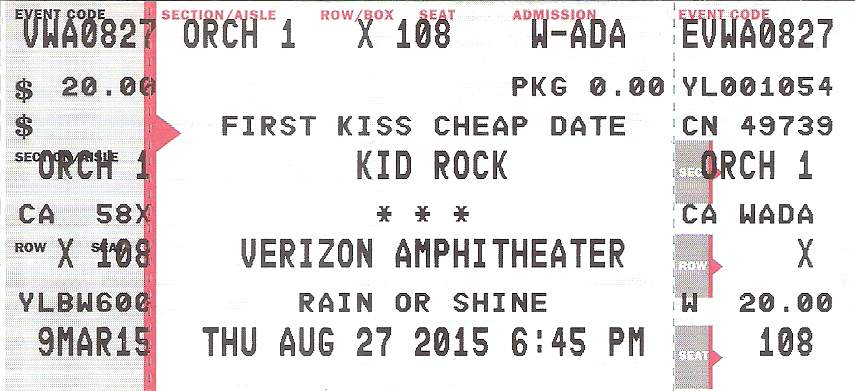
Kid Rock is bringing back the $20 ticket for his Cheap Date tour, which had a show at the Irvine Meadows Amphitheatre (my favorite southern California concert venue) last Thursday night. I’m also a Foreigner fan and, since they were opening for Kid Rock, I would be crazy to not get tickets. So I bought a pair and it turned out to be a beautiful, balmy summer night to attend a concert under the stars.
Kid Rock concert ticket
Foreigner hit the stage without a single member from the original lineup. But they brought the founder of the group, Mick Jones, out from the third song to the end of the show. At over seventy years of age, he’s lost much of his hair and what is remaining is all white. Mick doesn’t move around on the stage with the same energy he used to but his guitar playing was as strong as ever.
Foreigner (without Mick Jones)
The lead singer Kelly Hansen at age 54 is no spring chicken either. But he commanded the stage like someone half his age and must be in great shape to move with the energy he did. He even ended up in the middle of the audience a couple of times, once on a plinth twenty feet over the audience singing Juke Box Hero.
Kelly can still pull off the rocker look (reminiscent of Steven Tyler’s look on this night). But what most impressed me about him was his vocals. Foreigner songs are very difficult to sing but Kelly did not miss a single note. His voice was powerful, not even needing a falsetto for the high notes, and did not weaken a bit by the encore. In fact, Kelly sang even better than Lou Gramm did back when he fronted the band at live shows.
The rest of the band was as tight as can be. They were obviously well rehearsed because the songs sounded almost like the studio versions. The rhythm section kept a strong, driving beat going throughout the show that defied you to keep still. Although every song was at least thirty years old, they sounded fresh and offered just what the Foreigner fans wanted to hear.
Kid Rock
Kid Rock showed his versatility with his hits ranging from hip-hop to rock to country. Although he sang for most of the show, he played guitar on a couple of songs and also the drums and piano for one song each. Kid even stepped up to the platters for one song and showed that he can scratch with the best of DJs. Kid’s set was very diverse and he sprinkled it liberally with storytelling between the songs. He even spoke at length about aging since he’s not truly much of a kid anymore at 44 years old.
I thoroughly enjoyed Kid Rock’s show. He’s an entertaining performer and his band was solid too. But they weren’t quite as tight as Foreigner. Although it’s a close call, I think Foreigner’s show was even better than the Kid’s. They showed me that even old guys can rock!
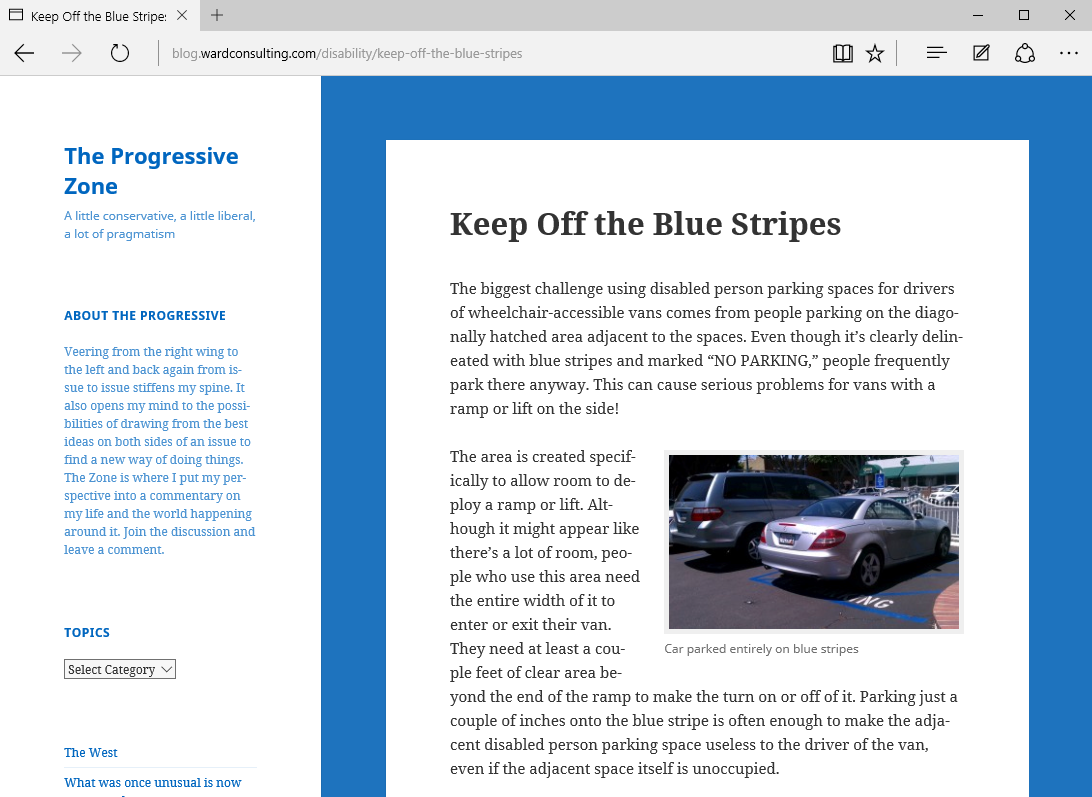
I discovered that the new Microsoft Edge browser automatically hyphenates copy. Browse to Keep off the blue stripes with any other browser and you won’t see any hyphens. The screen below is the same posting in Edge and you can see quite a few hyphens at the right margin of the copy.
Motivated by news that the Social Security disability trust fund could run dry soon, I wrote to my federal representatives. So far, only President Obama replied. Although his reply doesn’t directly address my concerns about the disability trust fund, he shared his position on Social Security in general:
Dear David:
Thank you for writing. It’s clear you have faced great challenges, and I want you to know I am listening. I have heard from many Americans who are concerned about their financial security in retirement, and I want you to know I am listening.
As President, one of my top priorities is keeping Social Security a rock-solid, guaranteed progressive benefit that every American can rely on. However, a Social Security check often is not enough on its own. After a lifetime of hard work, too many Americans reach their golden years unable to supplement their Social Security and enjoy a secure retirement. At a time when Americans are largely responsible for making their own choices about how much to save and how to invest their savings, my Administration is making it easier to prepare for retirement. In every budget I’ve put forward since taking Office, I’ve proposed legislation that would give 30 million additional workers access to a workplace savings opportunity. And last year, the Treasury Department launched “myRA,” a simple, safe, and no-fee savings program that stays with you even if you switch jobs.
At the same time, families who act responsibly by building up their savings should be able to trust that the retirement advice they receive is in their best interest. But right now, outdated regulations allow brokers to put their own financial gain ahead of their clients’ retirement security—costing savers approximately $17 billion each year. That is why my Administration is updating the rules and requirements for retirement investment advice. The bottom line is that what you earn on the nest egg you’ve worked a lifetime to build should work for you, not anybody else.
Again, thank you for sharing your thoughts. A critical test of the strength of our economy is whether hardworking Americans feel confident in their retirement security. As long as I hold this Office, I’ll keep fighting to preserve the basic bargain that anyone who works hard all their life can enjoy a stable and secure retirement.
Sincerely,
Barack Obama
In all fairness, there’s little President Obama can do about the disability trust fund at this point. When the fund runs dry, he will have to make some executive decisions but he’ll nearly be leaving the Oval Office by then. In the meantime, he can only respond to what congress brings to the table.
Coincidentally, I was reading chapter 53 of A Game of Thrones (A Song of Ice and Fire) today and seeing correlations with how things have changed in the USA. The chapter is about Bran, who became paraplegic from a spinal cord injury. Although it’s not as accessible to him as it was before he became paralyzed, Bran has been able to get out and around Winterfell because of a number of accommodations. In this chapter, Bran rises to the level of lord in Winterfell. Yet when he hosted a feast for Lord Karstark, Bran overheard one of Karstark’s sons saying “…sooner die than live like that” and the other referring to him as “broken inside as well as out”: Bran the Broken.
But there’s one place where the ADA, which is supposed to prohibit discrimination and ensure equal opportunity for persons with a disability, has fallen short—in regards to discrimination. As other civil rights movements have discovered, you can’t legislate discrimination away. In 2014, only seventeen percent of Americans with a disability were employed (compared to 64.6% of those without). Most people with a visible disability can tell anecdotes about when people talk to their companion regarding the person with the disability, even though they’re right there together and could answer for him or herself. While many Americans are enlightened about the capabilities of persons with a disability, too many still discriminate against them based on misconceptions and ignorance of what a person with a disability can accomplish. Does anyone remember that president Franklin D. Roosevelt had polio?
The only way to overcome discrimination is to raise awareness about persons with a disability. Recognizing the 25th anniversary of the ADA is one way to do that. Although I would never advocate intentionally doing so, becoming disabled yourself is another way—and it could happen to any of us. Just over 1 in 4 of today’s 20 year-olds will become disabled before they retire. If you don’t have a friend or family member with a disability, don’t be afraid to speak with someone with a disability you happen to meet about what they are capable of and what they’ve accomplished. Most are willing to speak candidly on the topic and you’re certain to be surprised by the stories you hear.
It would be interesting to see what America will be like for persons with a disability in another 25 years. I will not likely be around in 2040 to see it. But I hope those Americans who will be will see even more advancements in the next quarter of a century than in the last.
As a cycling aficionado, Le Tour de France is one of my favorite sporting events. Although to many it seems like an individual sport, I find the strategies of the teamwork required to win the Tour intriguing. When it gets into the Alps, it’s inspiring to see who gets defeated by the mountains rather than the other riders and who can overcome the grueling climbs. It’s exciting to watch the time trial specialists race the clock. But there’s one part of the Tour that I dislike because it’s a spoiler: the final stage.
In Le Tour de France, we always (with rare exceptions) know who the winner of the race will be before the race is even over. The man wearing the Yellow Jersey after the penultimate stage is known to be the winner of the Tour when there’s still a stage to go. Even though the final stage of the Tour is tomorrow, I can already tell you that Chris Froome will win the 2015 Tour de France.
Instead of racing tomorrow, the entire peleton will be taking a leisurely 110 kilometer ride through the French countryside. No one will try to overtake Froome or even be riding hard. In fact, Team Sky will be drinking champagne and toasting their victory while still “racing.” If you’ll be watching a recording of the final stage, don’t bother avoiding news about who will win the Tour because it’s already decided. This celebratory end to the race is completely devoid of suspense and takes all the excitement out of it for me.
The Tour organizers should end each race the way they did the 1989 Tour de France. The race ended with a time trial on the final stage in which the riders rode as hard as they could instead of loafing off. Greg LeMond came back from almost a one-minute deficit to Laurent Fignon to win the Tour in the final stage. It was the closest race in the Tour’s history, with LeMond beating Fignon by only eight seconds after about 2,100 miles of racing. That’s an exciting way to finish Le Tour de France!
I won’t bother watching the final stage of the Tour tomorrow. I already know who will win. I find the ceremony of the ride into the Champs-Elysées rather boring.
The USA and five other world powers (the P5+1) have finally reached a deal with Iran regarding its use of nuclear power. Before the ink was even dry on the agreement, politicians here in the US began decrying it as a bad deal. Their complaints are consistently about the terms of the agreement not being strict enough.
For example, Iran agreed to limit enrichment of uranium to 3.5% but critics of the agreement do not want Iran to enrich uranium at all. Another example is Iran’s agreement to allow international inspectors to inspect a suspect site with 24 days’ notice. Critics want inspectors to have unfettered access with no advance notice. Essentially, critics of the agreement are saying that the terms of the agreement should be terms that would be perfect to them.
The problem with that position is that the critics of the agreement are not taking into account how negotiation works. Each side begins negotiating for their perfect terms knowing full well that the other side won’t agree to them. Then both sides begin making concessions on some terms to get concessions on other terms that are more important to the negotiating party. Eventually through this process of give and take, both parties reach an agreement with terms that are not perfect for either party but are somewhere in the middle of what both sides would consider perfect. Negotiations require compromise to be successful.
Critics of the Iran deal think that the deal should be evaluated as a choice between the terms that were agreed to and the perfect terms. But that’s unreasonable because Iran would never have agreed to the terms that would be perfect for the US. Instead, the deal should be evaluated as a choice between the terms that were agreed to and the status quo. The status quo is no deal at all.
Evaluated from this perspective, the agreement with Iran is a good deal because the terms reached are far more restrictive on Iran’s ability to produce a nuclear weapon than no deal at all. Considering that seven countries were involved in negotiations, the international community is lucky that any deal could be reached. To borrow an adage from Voltaire, we should not allow a perfect deal to be the enemy of a good deal with Iran.
I traveled around the country quite a bit when I was younger and was inspired by my travels to write the lyrics to The West. My brother Mike put the lyrics to some music he created and also came up with the melody and harmonies for the song, as well as the arrangement. Then my brother Daniel recorded it with me singing and Mike playing guitar. Play this video (above) to hear the song and here are the lyrics…
Watch the sun, sets in the west,
Drops beneath the ocean crest.
Cool waters, deep and blue;
Golden sunrays warm me through.
Pretty girls and sandy beaches;
Follow the sun to its far off reaches.
From the mountains to the sea I know that it’s the best,
I’ve been around enough to see my home is in the West.
Look to the mountains standing high,
Jagged peaks at the edge of the sky.
Blankets the ground, white snow so cold,
Frosting the pine trees countless years old.
Breathe in the air so crisp and pure,
Feels so strong, feels just like a cure.
From the mountains to the sea I know that it’s the best,
I’ve been around enough to see my home is in the West.
I’ve traveled the land far and wide,
Good times always there at my side.
Now through it all there’s one thing I see;
There’s only one place I’d rather be.
And when my soul yearns for a rest,
‘Turn to my home, back to the West.
From the mountains to the sea I know that it’s the best,
I’ve been around enough to see my home is in the West.
I know my home is in the West
I know my home is in the West
I know my home is in the West
I know my home is in the West